Collection › Zimbabwe › #670
10000000000 ZWL
P-85
AI extracted
✦ AI 93%
The AI flagged these for your attention. Use ✦ Fact-check to cross-check factual fields against another model's world-knowledge, or 🔍 Re-look at image when you suspect the AI misread the pixels.
-
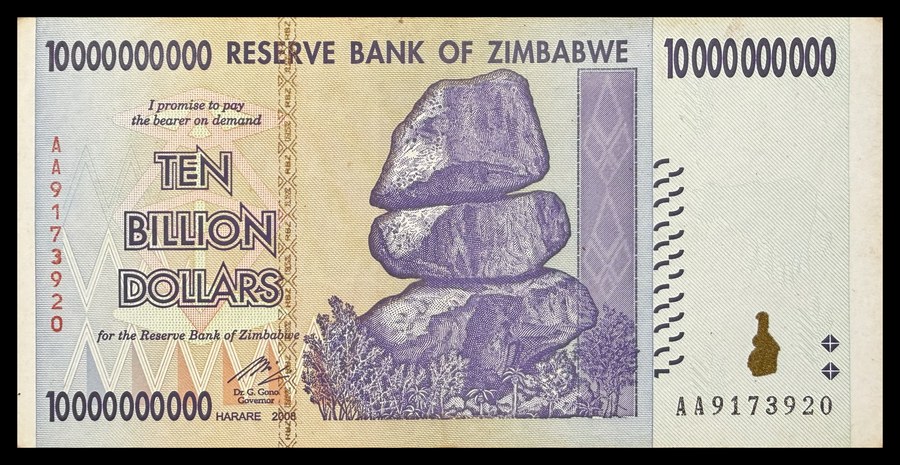
Auto-crop on the FRONT was uncertain (not a clean rectangle).Use ✂ Re-crop to mark the corners by hand.
IMG_7537.HEIC
cropped
IMG_7538.HEIC
cropped
Where & when
What's on the note
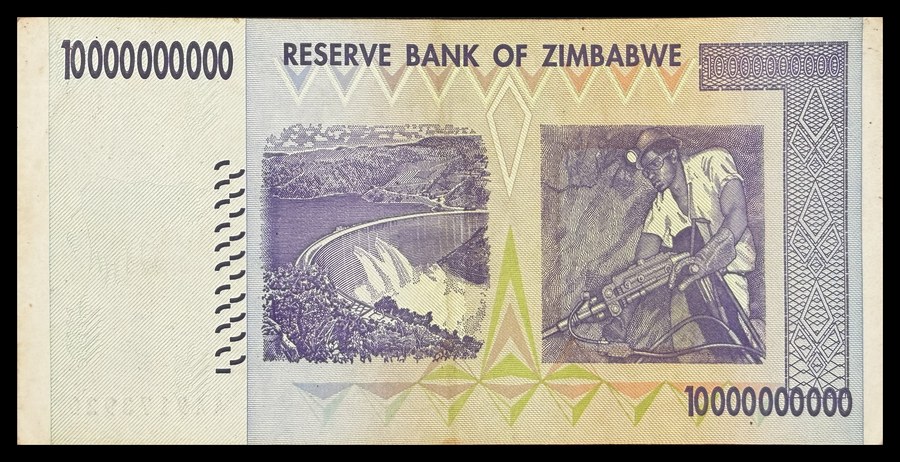
Front: The Chiremba Balancing Rocks, a natural geological formation near Harare and Epworth that appears on Zimbabwe's coat of arms and has been a national symbol since independence. The rocks represent the need for balanced development and are one of Zimbabwe's most iconic landmarks. The front also features traditional African geometric patterns and palm trees, symbolizing Zimbabwe's natural beauty and agricultural heritage.
Back: Three balancing rocks stacked naturally, representing the Chiremba Balancing Rocks formation. These granite rock formations are a distinctive geological feature of Zimbabwe's landscape and have become a powerful national symbol representing stability, balance, and the delicate equilibrium of nature. The signature 'Dr. G. Gono Governor' appears at bottom, along with the date 'HARARE 2008' and serial number prefix 'AA 91739920'.
How it was made
Signatures: Governor: Dr. G. Gono
Security features: thread, microprint, see_through_register, intaglio
Zimbabwe in Africa
Zimbabwe in Africa. Other countries on the same continent shown in muted grey.
Background & history
This 10 Billion Dollar note was issued during Zimbabwe's catastrophic hyperinflation period of 2007–2008, which peaked at an estimated 89.7 sextillion percent per month in November 2008. The Third Zimbabwe Dollar (ZWL, redenominated August 2008 at 10^10:1 from the Second Dollar) was itself abandoned in April 2009 when Zimbabwe suspended its currency and adopted a multi-currency system dominated by the US Dollar and South African Rand. Governor Gideon Gono oversaw the Reserve Bank during this period (2003–2013). The note was printed in Harare by Fidelity Printers and Refiners. The serial prefix 'AA' indicates early production in the series. This denomination represents one of the most extreme examples of hyperinflation in modern economic history, comparable only to Hungary 1946 and Weimar Germany 1923. Despite the enormous face value, at issue this note could buy only basic groceries for a day or two. The note is now demonetized and has no legal tender value, though it remains popular with collectors as a historical artifact of hyperinflation.
Collector references
How it came to me
What it's worth now
Valuation history (1)
| date | low | high | currency | source | note |
|---|---|---|---|---|---|
| 2026-05-10 07:51:49 | 5.0 | 15.0 | USD | ai | from claude-sonnet-4-5 |
History & extractions
AI extractions (1)
Edits & decisions (0)
No edits yet.
Manual fixups
Find near-duplicates
Manual pairing override
Edit specimen #670
All fields below post to the same save endpoint. Sections collapse to focus on what you need.
Re-crop manually
Drag the four corners to mark the banknote in each image. Click Save crop to apply.