Collection › Zimbabwe › #671
10000000000 ZWD
P-P-85
AI extracted
✦ AI 93%
IMG_7539.HEIC
cropped
IMG_7540.HEIC
cropped
Where & when
What's on the note
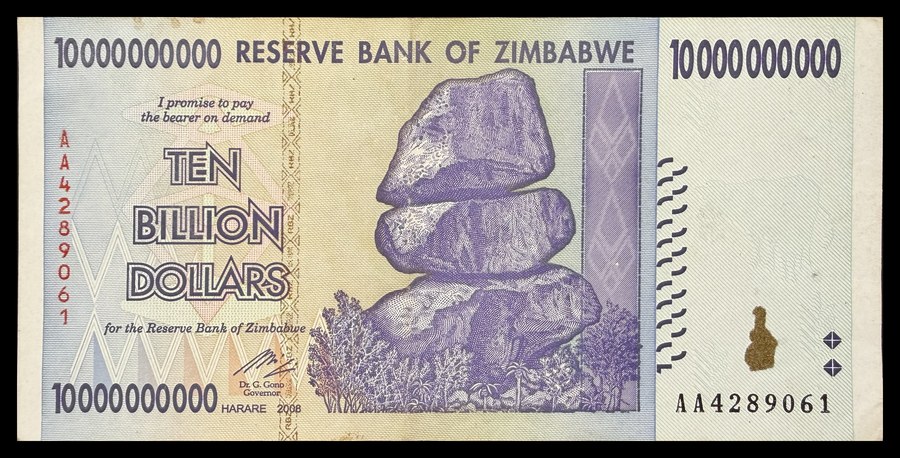
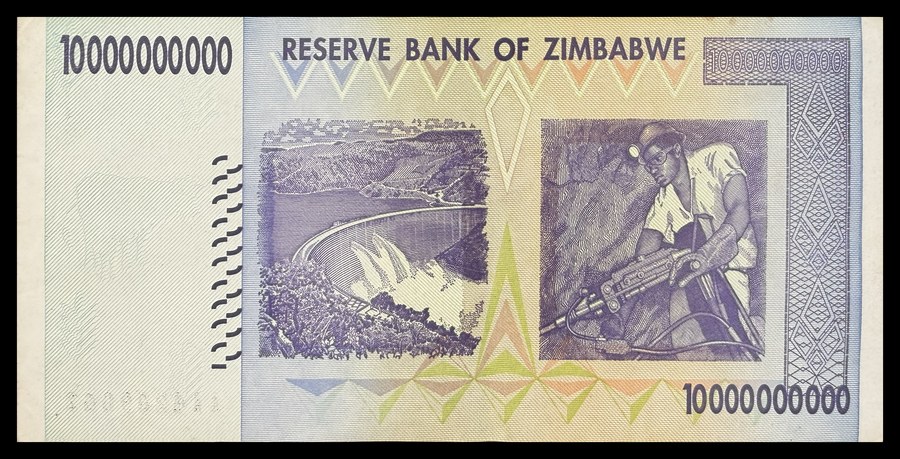
Front: Agricultural and industrial scenes representing Zimbabwe's economy: left panel shows harvesting of crops (likely cotton or tobacco) with basket, right panel depicts a weaver or craftsperson working at a loom or traditional craft station. These motifs symbolize the agricultural base and artisan industry that were central to Zimbabwe's economy before the hyperinflation crisis. The imagery reflects the government's attempt to maintain normalcy and economic optimism during the period of catastrophic currency collapse.
Back: Balancing Rocks (also known as balanced rocks or kopjes), one of Zimbabwe's most iconic natural geological formations found at sites including Epworth near Harare and the Matopos Hills. These precariously stacked granite boulders are a symbol of Zimbabwe's unique landscape and have appeared on Zimbabwean currency since the Rhodesian era. The formation represents natural balance and stability—an ironic symbol given the hyperinflationary context of this note's issuance.
How it was made
Signatures: Governor: Dr. G. Gono
Security features: thread, microprint, intaglio, latent_image
Zimbabwe in Africa
Zimbabwe in Africa. Other countries on the same continent shown in muted grey.
Background & history
This 10 billion dollar note was issued in 2008 during Zimbabwe's catastrophic hyperinflation period, one of the worst currency collapses in recorded history. The Reserve Bank of Zimbabwe, under Governor Gideon Gono (who served 2003–2013), issued increasingly large denominations as inflation spiraled out of control, reaching an estimated 89.7 sextillion percent month-on-month by mid-November 2008. The note is dated 'HARARE 2008' on the back. This particular denomination represents the third redenomination (the second dollar, ZWD): 1 new dollar = 10 billion old dollars. The currency was eventually abandoned in April 2009 when Zimbabwe adopted a multi-currency system using the US dollar, South African rand, and other foreign currencies. The serial prefix 'AA' indicates an early print run within this denomination. Despite the astronomical face value, these notes had virtually no purchasing power even when issued—by late 2008, this note might have bought a loaf of bread or a few eggs. Today these hyperinflation notes are widely collected as historical artifacts documenting economic collapse. Dr. Gideon Gono's signature appears on all notes from this era.
Collector references
How it came to me
Appears uncirculated with crisp paper and sharp corners, typical of notes that circulated minimally due to rapid currency devaluation.
What it's worth now
Valuation history (1)
| date | low | high | currency | source | note |
|---|---|---|---|---|---|
| 2026-05-10 07:51:52 | 3.0 | 8.0 | USD | ai | from claude-sonnet-4-5 |
History & extractions
AI extractions (1)
Edits & decisions (0)
No edits yet.
Manual fixups
Find near-duplicates
Manual pairing override
Edit specimen #671
All fields below post to the same save endpoint. Sections collapse to focus on what you need.
Re-crop manually
Drag the four corners to mark the banknote in each image. Click Save crop to apply.