Collection › Zimbabwe › #672
10000000000000 ZWL
P-P-85
AI extracted
✦ AI 95%
IMG_7541.HEIC
cropped
IMG_7542.HEIC
cropped
Where & when
What's on the note
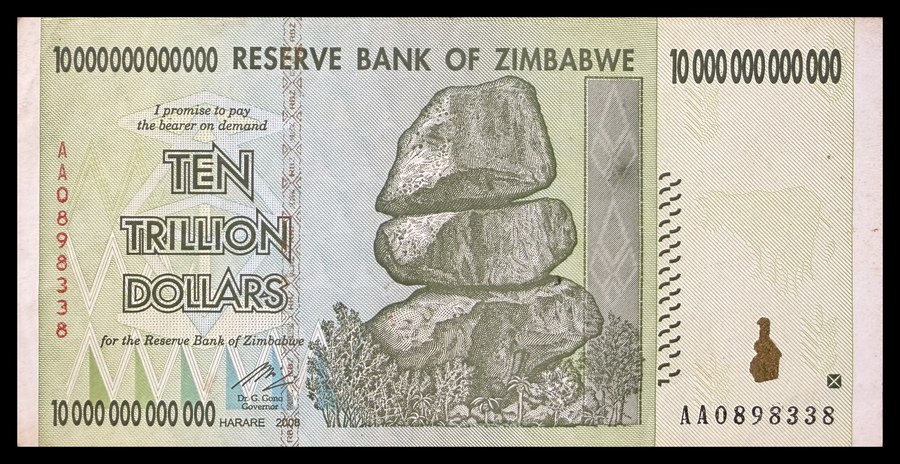
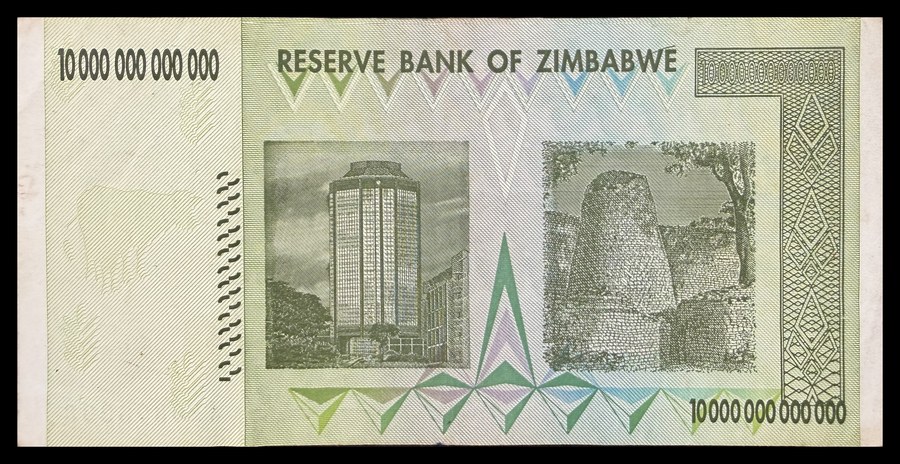
Front: Agricultural and wildlife imagery representing Zimbabwe's economy: at left, a traditional fish trap (chirundu) used in subsistence fishing along rivers such as the Zambezi; at right, an African buffalo (Syncerus caffer), one of Africa's Big Five game animals, standing in grassland. These motifs symbolize Zimbabwe's reliance on both agriculture and natural resources during the period of economic crisis and hyperinflation that saw the Reserve Bank issue banknotes reaching into the trillions of dollars.
Back: Balancing Rocks formation (also known as the Balancing Stones or Chiremba Balancing Rocks), one of Zimbabwe's most iconic natural landmarks found in Epworth and Matobo Hills. These granite formations are a national symbol appearing on Zimbabwe's currency and coat of arms, representing stability and endurance. The rocks are a product of millions of years of erosion and have cultural significance to the indigenous Shona people, also serving as a key tourist attraction and symbol of Zimbabwe's geological heritage.
How it was made
Signatures: Governor: Dr. G. Gono
Security features: thread, microprint, latent_image, intaglio
Zimbabwe in Africa
Zimbabwe in Africa. Other countries on the same continent shown in muted grey.
Background & history
This 10 trillion dollar note was issued in 2008 during the catastrophic Zimbabwean hyperinflation (2007–2009), when inflation reached an estimated 89.7 sextillion percent per month by mid-November 2008. The Reserve Bank of Zimbabwe, under Governor Gideon Gono, issued increasingly large denominations culminating in the 100 trillion dollar note in 2009. The Third Zimbabwean Dollar (ZWL, code 932) was introduced on August 1, 2008, at a rate of 10 billion Second Dollars to 1 Third Dollar. Despite redenominations, hyperinflation continued unabated, driven by land reform policies, loss of agricultural production, government deficit spending, and loss of confidence. The currency was officially demonetized on April 12, 2009, when Zimbabwe adopted a multi-currency system using primarily USD, South African rand, and other stable foreign currencies. These hyperinflation notes are now widely collected as historical artifacts of economic collapse. The note was printed domestically by Fidelity Printers and Refiners in Harare. The signature of Dr. Gideon Gono, who served as Governor from 2003 to 2013, appears on all notes from this era.
Collector references
How it came to me
What it's worth now
Valuation history (1)
| date | low | high | currency | source | note |
|---|---|---|---|---|---|
| 2026-05-10 07:51:50 | 5.0 | 15.0 | USD | ai | from claude-sonnet-4-5 |
History & extractions
AI extractions (1)
Edits & decisions (0)
No edits yet.
Manual fixups
Find near-duplicates
Manual pairing override
Edit specimen #672
All fields below post to the same save endpoint. Sections collapse to focus on what you need.
Re-crop manually
Drag the four corners to mark the banknote in each image. Click Save crop to apply.