Collection › Zimbabwe › #676
50 Billion Dollars ZWD
P-87
AI extracted
✦ AI 92%
The AI flagged these for your attention. Use ✦ Fact-check to cross-check factual fields against another model's world-knowledge, or 🔍 Re-look at image when you suspect the AI misread the pixels.
-
Some fields the AI was unsure about — please verify:
- Printer: “—” (30%)
Click ✦ Ask AI to verify or fix any below.
IMG_7549.HEIC
cropped
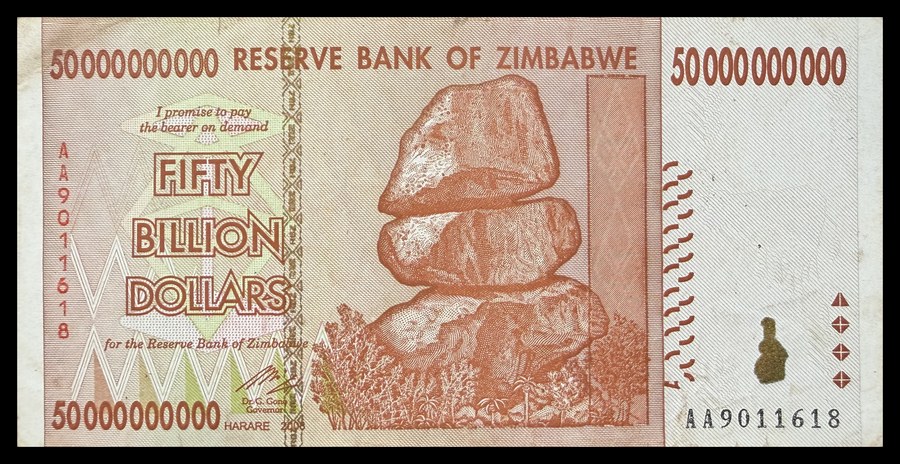
IMG_7550.HEIC
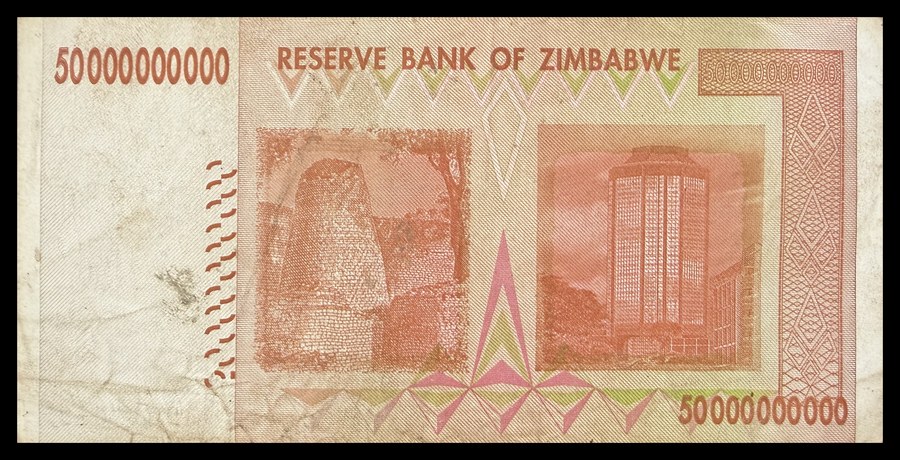
cropped
Where & when
What's on the note
Front: The Reserve Bank of Zimbabwe headquarters building in Harare at left center, a modernist high-rise structure completed in the 1990s that serves as the central bank's main office. At right, the Chiremba Balancing Rocks, a natural geological formation of precariously balanced granite boulders near Harare that appears on Zimbabwe's currency and serves as a national symbol. The note displays the astronomical denomination of 10 trillion Zimbabwe dollars (10,000,000,000,000), characteristic of the hyperinflationary period.
Back: Chiremba Balancing Rocks formation, a stack of naturally balanced granite boulders that has become an iconic symbol of Zimbabwe, representing the nation's geological heritage and serving as a metaphor for balance and stability. This natural stone formation near Harare has appeared on Zimbabwean currency since independence and is one of the country's most recognizable landmarks. The back displays '50 Billion Dollars' and serial number AA9011618.
How it was made
Signatures: Governor: Gideon Gono
Security features: thread, microprint, latent_image
Zimbabwe in Africa
Zimbabwe in Africa. Other countries on the same continent shown in muted grey.
Background & history
This 50 billion dollar note was issued during Zimbabwe's catastrophic hyperinflation crisis of 2008–2009, the second-worst case of hyperinflation in recorded history. The Third Dollar series (ZWD) was introduced in August 2008, redenominating at 10 billion old dollars to 1 new dollar, but inflation continued to spiral out of control. By late 2008, inflation reached an estimated 89.7 sextillion percent month-on-month. The Reserve Bank, under Governor Gideon Gono, issued increasingly higher denominations, ultimately reaching 100 trillion dollars. The currency became practically worthless for daily transactions, leading to its abandonment in April 2009 when Zimbabwe adopted a multi-currency system using primarily the US dollar and South African rand. These hyperinflation-era notes, while once representing enormous face values, are now collected as historical artifacts of economic collapse.
Collector references
How it came to me
Appears uncirculated with crisp edges and no visible wear
What it's worth now
Valuation history (1)
| date | low | high | currency | source | note |
|---|---|---|---|---|---|
| 2026-05-10 07:53:11 | 5.0 | 15.0 | USD | ai | from claude-sonnet-4-5 |
History & extractions
AI extractions (1)
Edits & decisions (0)
No edits yet.
Manual fixups
Find near-duplicates
Manual pairing override
Edit specimen #676
All fields below post to the same save endpoint. Sections collapse to focus on what you need.
Re-crop manually
Drag the four corners to mark the banknote in each image. Click Save crop to apply.