Type details
| Country | China |
| Currency | CNY |
| Denomination | 10 Yuan |
| Series | Fourth series |
| Series year | 1980 |
| Series range | 1987–2018 |
| Issue year | 1980 |
| Issuer | People's Bank of China |
| Issuer (native) | 中国人民银行 |
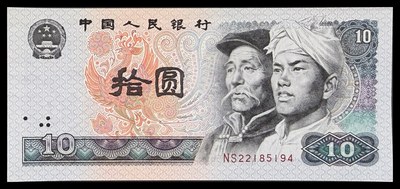
| Front portrait | Han and Mongol ethnic representatives |
| Reverse subject | Mount Everest |
| Themes | indigenous_culture,wildlife,architecture |
| Watermark | Tiananmen Gate pattern in clear field |
| Security features | thread,microprint,intaglio,see_through_register |
| Colour palette | #d4a574,#8b9d9f,#c08080 |
| Material | paper |
| Dimensions (mm) | 155x70 |
| Language / script | Chinese (Simplified), Mongolian, Tibetan, Uyghur, Zhuang |
| Languages | zh,mn,bo,ug,za |
| Pick # | P-329 |
| Rarity | common |
| Legal status | demonetized |
| Legal status date | 2019-05-01 |
| Predecessor currency | Third series Renminbi |
| Successor currency | Fifth series Renminbi |
| Era | 1946_1989 |
| Default value (low) | 3.0 |
| Default value (high) | 10.0 |
| Value currency | USD |
Front
Portraits of a Han Chinese man and a Mongol man representing China's ethnic diversity. The Fourth series renminbi (1987–2018) was the first to feature portraits of ethnic minorities rather than political leaders, symbolizing national unity and the multi-ethnic character of the People's Republic. Each denomination depicts different ethnic groups from China's officially recognized 56 nationalities, emphasizing cultural harmony and socialist inclusiveness.
Back
Mount Everest (Chomolungma/Sagarmatha), the world's highest peak at 8,848 metres, located on the China-Nepal border in the Himalayas. Known in Tibetan as Chomolungma ('Goddess Mother of the World') and measured from the Chinese side, Everest has been a symbol of China's territorial extent and natural majesty. The mountain appears on this denomination as part of the Fourth series' theme of showcasing China's diverse landscapes and natural wonders.
History
The Fourth series renminbi was issued between 1987 and 1997 (dates printed 1980, 1990, 1996) and circulated until full demonetization on May 1, 2019. This series marked a significant shift in Chinese banknote design philosophy, replacing portraits of political figures with depictions of China's ethnic minorities and natural landscapes. The 10 yuan note specifically features Han and Mongol representatives on the obverse and Mount Everest on the reverse. The text includes Chinese, Mongolian, Tibetan, Uyghur, and Zhuang scripts, reflecting the multilingual nature of the People's Republic. This series coincided with China's economic reforms and opening-up period under Deng Xiaoping.
Linked specimens (1)
Merge into another type
Repoints every linked specimen above to the chosen target type, fills any target nulls from this type, then deletes this type. This cannot be undone.