100 Croatian Dinar #133
First Croatian Dinar series
(1991–1994)
· issued 1991
· P-20a
· common
Type details
| Country | Croatia |
| Currency | Croatian Dinar |
| Denomination | 100 |
| Series | First Croatian Dinar series |
| Series year | 1991 |
| Series range | 1991–1994 |
| Issue year | 1991 |
| Issuer | Republic of Croatia |
| Issuer (native) | Republika Hrvatska |
| Signatures | Ministar Financija: (signature present) |
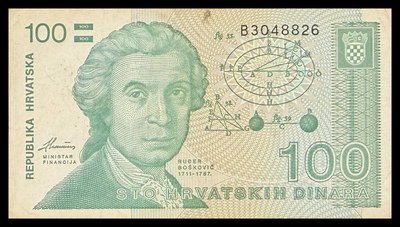
| Front portrait | Ruđer Bošković |
| Reverse subject | Zagreb Cathedral |
| Themes | scientist,architecture,religion |
| Watermark | Portrait of Ruđer Bošković in clear field |
| Security features | microprint,intaglio,latent_image,see_through_register |
| Colour palette | #8fbc8f,#f5deb3,#2f4f2f |
| Material | paper |
| Dimensions (mm) | 150x72 |
| Language / script | Latin |
| Languages | hr |
| Pick # | P-20a |
| Rarity | common |
| Legal status | demonetized |
| Legal status date | 1994-05-30 |
| Predecessor currency | Yugoslav Dinar |
| Successor currency | Croatian Kuna |
| Era | 1990_present |
| Default value (low) | 2.0 |
| Default value (high) | 5.0 |
| Value currency | USD |
Front
Ruđer Bošković (1711–1787), Croatian physicist, astronomer, mathematician, philosopher, diplomat, poet, and Jesuit priest. He is best known for his atomic theory and his work in astronomy and mathematics; he produced a precursor to atomic theory and made significant contributions to the determination of a meridian arc. Bošković was one of the greatest scientists of his era and is celebrated as a national hero in Croatia. The inscription 'STO HRVATSKIH DINARA' (One Hundred Croatian Dinars) appears at bottom, with the Croatian coat of arms (red-and-white checkerboard shield) at upper right.
Back
Zagreb Cathedral (Cathedral of the Assumption of the Blessed Virgin Mary), the tallest building in Croatia and a symbol of Zagreb. The Gothic-style cathedral was originally constructed in the 13th century, destroyed by the Mongols in 1242, rebuilt, and subsequently modified with Neo-Gothic twin spires added in the late 19th century after an 1880 earthquake. It is the seat of the Archbishop of Zagreb and one of Croatia's most important religious and architectural landmarks.
History
This 100-dinar note belongs to the first Croatian Dinar series issued following Croatian independence from Yugoslavia in 1991. The Croatian dinar was introduced on December 23, 1991, to replace the Yugoslav dinar at par, and served as Croatia's currency during the period of the Croatian War of Independence and early statehood. The series featured prominent Croatian historical figures and landmarks to assert national identity. The dinar was replaced by the Croatian kuna on May 30, 1994, at a rate of 1 kuna = 1,000 dinars, following a period of hyperinflation. The choice of Ruđer Bošković reflected Croatia's emphasis on its scientific and cultural heritage.
Linked specimens (1)
Merge into another type
Repoints every linked specimen above to the chosen target type, fills any target nulls from this type, then deletes this type. This cannot be undone.