Type details
| Country | Egypt |
| Currency | Egyptian pound |
| Denomination | 5 piastres |
| Series | Law No. 50/1940 series |
| Series year | 1940 |
| Series range | 1940–1950 |
| Issuer | Ministry of Finance of the Arab Republic of Egypt |
| Issuer (native) | وزير المالية |
| Signatures | Minister of Finance: Saleh Hamed |
| Printer | Postal Printing House |
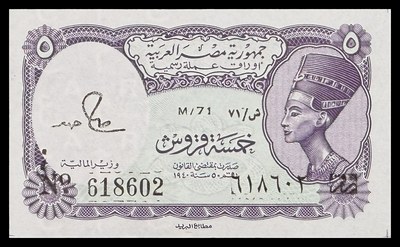
| Front portrait | Tutankhamun |
| Themes | monarch,ancient_history |
| Watermark | Portrait of Tutankhamun in clear field at center-left |
| Security features | microprint,intaglio |
| Colour palette | #8b7aa0,#d4c5b9,#4a3c54 |
| Material | paper |
| Language / script | Arabic,Latin |
| Languages | ar,en |
| Pick # | 163 |
| Rarity | common |
| Legal status | demonetized |
| Legal status date | 1950 |
| Era | 1900_1945 |
| Default value (low) | 5.0 |
| Default value (high) | 15.0 |
| Value currency | USD |
Front
Tutankhamun (c. 1341–1323 BCE), pharaoh of Egypt's Eighteenth Dynasty during the New Kingdom period. He ascended to the throne at around age nine and ruled until his death at approximately eighteen; his tomb (KV62) discovered by Howard Carter in 1922 is one of the most famous archaeological finds in history. The portrait shows him wearing the iconic Nefertiti-style crown (actually the Blue Crown or Khepresh), and his image became emblematic of Egyptian currency during the mid-20th century.
Back
Geometric guilloche patterns surrounding the denomination '5 PIASTRES' with bilingual inscriptions in Arabic and English identifying the issuing authority as 'The Arab Republic of Egypt' and 'ISSUED UNDER LAW No. 50/1940'. The signature of Saleh Hamed as Minister of Finance appears in both Arabic and English.
History
This note belongs to the Law No. 50/1940 series issued by the Egyptian Ministry of Finance during World War II and the final years of the British protectorate period. These currency notes were printed domestically by the Postal Printing House rather than by foreign printers, reflecting Egypt's move toward greater monetary independence. The series circulated until the early 1950s when replaced by later issues following the Egyptian Revolution of 1952. The use of Tutankhamun's image on Egyptian currency began in this era and continued for decades, symbolizing national heritage and pharaonic legacy.
Linked specimens (1)
Merge into another type
Repoints every linked specimen above to the chosen target type, fills any target nulls from this type, then deletes this type. This cannot be undone.