Type details
| Country | Egypt |
| Currency | EGP |
| Denomination | 5 |
| Series range | 1990s-2000s |
| Issuer | Central Bank of Egypt |
| Issuer (native) | البنك المركزي المصري |
| Signatures | Governor: Hesham Ramez |
| Reverse subject | Mosque of Ibn Tulun |
| Themes | architecture,religion,indigenous_culture |
| Watermark | Tutankhamun's death mask in clear field |
| Security features | thread,microprint,intaglio |
| Colour palette | #d4c5a0,#8b7355,#4a5f4a |
| Material | paper |
| Dimensions (mm) | 166x86 |
| Language / script | Arabic script with Latin text on front |
| Languages | ar,en |
| Pick # | 56 |
| Rarity | common |
| Legal status | withdrawn |
| Era | 1990_present |
| Default value (low) | 2.0 |
| Default value (high) | 5.0 |
| Value currency | USD |
Front
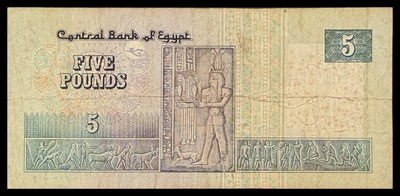
Ancient Egyptian motifs depicting scenes from pharaonic civilization including agricultural workers in the lower register and a central figure playing a harp, representing Egypt's rich cultural heritage. The imagery draws from temple reliefs and tomb paintings that documented daily life and religious practices in ancient Egypt. These scenes symbolize the continuity between ancient and modern Egyptian identity, a recurring theme on Central Bank of Egypt banknotes from this era.
Back
The Mosque of Ibn Tulun in Cairo, completed in 879 CE and one of the oldest mosques in Egypt still standing in its original form. Built by Ahmad ibn Tulun, founder of the Tulunid dynasty, it features a distinctive spiral minaret (malwiya) and is the largest mosque in Cairo by area. The mosque represents Islamic architectural heritage and is a UNESCO-recognized monument, symbolizing Egypt's medieval Islamic Golden Age and its position as a center of Islamic civilization.
History
This five pound note is part of a series issued by the Central Bank of Egypt during the 1990s-2000s period. The design combines pharaonic motifs on the obverse with Islamic architecture on the reverse, reflecting Egypt's dual identity as inheritor of both ancient Egyptian and Islamic civilizations. The note features extensive Arabic text and Eastern Arabic numerals alongside Western Arabic numerals. This series was eventually replaced by newer designs with enhanced security features.
Linked specimens (1)
Merge into another type
Repoints every linked specimen above to the chosen target type, fills any target nulls from this type, then deletes this type. This cannot be undone.