Type details
| Country | Estonia |
| Currency | EEK |
| Denomination | 1 |
| Series | First kroon series |
| Series year | 1992 |
| Series range | 1992–2007 |
| Issue year | 1992 |
| Issuer | Bank of Estonia |
| Issuer (native) | Eesti Pank |
| Signatures | President: R. Otsason; Chairman of the Supervisory Board: Siim Kallas |
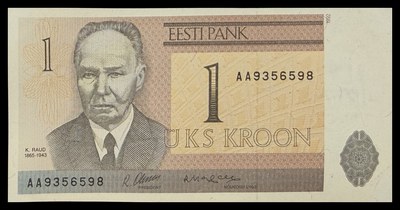
| Front portrait | Kristjan Raud |
| Reverse subject | Toompea Castle |
| Themes | artist,architecture |
| Security features | microprint,intaglio,latent_image |
| Colour palette | #d4b896,#8b7355,#f5e6d3 |
| Material | paper |
| Dimensions (mm) | 120x60 |
| Language / script | Latin |
| Languages | et |
| Pick # | P-69 |
| Rarity | common |
| Legal status | demonetized |
| Legal status date | 2011-01-15 |
| Predecessor currency | Ruble |
| Successor currency | Euro |
| Era | 1990_present |
| Default value (low) | 2.0 |
| Default value (high) | 5.0 |
| Value currency | USD |
Front
Kristjan Raud (1865–1943), Estonian painter and graphic artist, one of the founders of Estonian national art. Raud is celebrated for his contributions to Estonian cultural identity through his paintings and illustrations depicting Estonian mythology, folklore, and rural life, particularly his illustrations for the national epic Kalevipoeg. He was a founding member of the Estonian Artists' Association and played a pivotal role in establishing a distinctly Estonian artistic tradition during the National Awakening period.
Back
Toompea Castle in Tallinn, the seat of the Riigikogu (Estonian Parliament). Originally built as a fortress by the Teutonic Order in the 13th–14th centuries on Toompea hill, the castle has served as the seat of power in Estonia for over 700 years. The distinctive pink baroque façade visible on the note was added in the 18th century when the building served as the seat of the Russian Governor-General of Estonia. The castle symbolizes Estonian statehood and sovereignty, making it an appropriate choice for the nation's restored currency.
History
First kroon series, issued in 1992 following Estonia's restoration of independence from the Soviet Union in 1991. The Estonian kroon (EEK) replaced the Soviet ruble at a rate of 1 kroon = 10 rubles as part of monetary reform that established one of the most stable currencies in Eastern Europe. The series was designed to emphasize Estonian national identity and cultural heritage, featuring prominent Estonian cultural figures on the obverse and architectural landmarks on the reverse. The 1 kroon note, the smallest denomination, honored Kristjan Raud as a symbol of Estonian national art and cultural awakening. The kroon remained in circulation until January 1, 2011, when Estonia adopted the euro, becoming the first former Soviet republic to join the eurozone.
Linked specimens (1)
Merge into another type
Repoints every linked specimen above to the chosen target type, fills any target nulls from this type, then deletes this type. This cannot be undone.