Type details
| Country | Estonia |
| Currency | EEK |
| Denomination | 2 |
| Series | First kroon series |
| Series year | 1992 |
| Series range | 1992–2007 |
| Issue year | 1992 |
| Issuer | Bank of Estonia |
| Issuer (native) | Eesti Pank |
| Signatures | President: signature present; Noukogu liige: signature present |
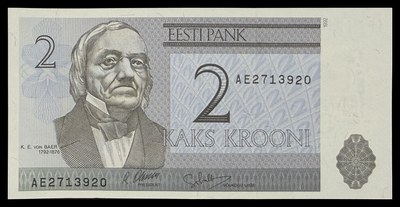
| Front portrait | Karl Ernst von Baer |
| Reverse subject | University of Tartu main building |
| Themes | scientist,architecture |
| Security features | intaglio,microprint,thread |
| Colour palette | #8b9ba8,#d4d4d4,#1a1a1a |
| Material | paper |
| Dimensions (mm) | 120x60 |
| Language / script | Latin |
| Languages | et |
| Pick # | P-70 |
| Rarity | common |
| Legal status | demonetized |
| Legal status date | 2011-01-15 |
| Predecessor currency | Soviet ruble |
| Successor currency | Euro |
| Era | 1990_present |
| Default value (low) | 2.0 |
| Default value (high) | 5.0 |
| Value currency | USD |
Front
Karl Ernst von Baer (1792–1876), Baltic German naturalist, biologist, geologist, meteorologist, geographer, and a founding father of embryology. He discovered the mammalian ovum and the notochord, formulated the germ layer theory of development, and made significant contributions to comparative anatomy and anthropology. Von Baer was born in what is now Estonia and is honoured as one of the most distinguished scientists associated with the region; his work established fundamental principles of developmental biology that remain influential to this day.
Back
The University of Tartu main building, a neoclassical structure completed in 1809 and designed by Johann Wilhelm Krause. The university, founded in 1632 by King Gustavus Adolphus of Sweden, is the oldest and most prestigious university in Estonia and one of the oldest in Northern Europe. The building serves as the symbolic heart of Estonian higher education and intellectual life, representing the country's academic traditions and commitment to scholarship.
History
This note belongs to the first kroon series issued in 1992 following Estonia's restoration of independence from the Soviet Union in 1991. The Estonian kroon replaced the Soviet ruble at a rate of 1 kroon = 10 rubles, marking a crucial step in Estonia's economic independence and transition to a market economy. The series was designed to celebrate Estonian national identity and cultural heritage, featuring prominent historical figures and landmarks. The kroon remained in circulation until January 1, 2011, when Estonia adopted the euro, becoming the 17th eurozone member. The 2-kroon denomination was among the lower-value notes of the series and circulated widely throughout the 1990s and 2000s.
Linked specimens (1)
Merge into another type
Repoints every linked specimen above to the chosen target type, fills any target nulls from this type, then deletes this type. This cannot be undone.