Type details
| Country | France |
| Currency | FRF |
| Denomination | 5 |
| Series | Berger series |
| Series year | 1943 |
| Series range | 1943–1947 |
| Issue year | 1943 |
| Issuer | Banque de France |
| Issuer (native) | Banque de France |
| Signatures | Le Secrétaire Général: Mourgue |
| Printer | Banque de France Printing Works |
| Front portrait | The Shepherd (allegorical figure) |
| Reverse subject | The Shepherdess (allegorical figure) |
| Themes | agriculture,pastoral |
| Watermark | None |
| Security features | intaglio,microprint |
| Colour palette | #8b7355,#6b8e23,#4682b4 |
| Material | paper |
| Dimensions (mm) | 100x60 |
| Language / script | Latin |
| Languages | fr |
| Pick # | P-98a |
| Rarity | common |
| Legal status | demonetized |
| Legal status date | 1963-01-01 |
| Predecessor currency | Franc (pre-1960) |
| Successor currency | Nouveau Franc |
| Era | 1900_1945 |
| Default value (low) | 3.0 |
| Default value (high) | 8.0 |
| Value currency | USD |
Front
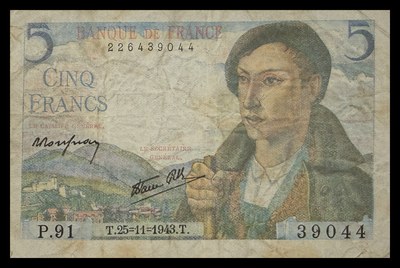
Young shepherd boy depicted in traditional pastoral attire with mountainous rural French landscape in background. This allegorical figure represents France's agricultural heritage and was part of a wartime series emphasizing traditional French values. The 'Berger' (Shepherd) series was issued during the German occupation of France and featured idealized pastoral imagery rather than political figures, reflecting Vichy government aesthetics promoting return to traditional rural life.
Back
Young shepherdess depicted in pastoral dress surrounded by agricultural bounty including wheat sheaves, fruits, and flowers. This allegorical female figure complements the shepherd on the front, symbolizing France's agricultural abundance and traditional rural economy. The text 'LE CONTREFACTEUR SERA PUNI DES TRAVAUX FORCÉS A PERPÉTUITÉ' (The counterfeiter will be punished by forced labor for life) appears as an anti-counterfeiting warning.
History
The 5 Francs Berger (Shepherd) series was issued by the Banque de France from 1943 to 1947, during and immediately after World War II. Dated 25-11-1943 (November 25, 1943), this note was printed during the German occupation. The series deliberately avoided portraits of political figures, instead using idealized pastoral imagery that aligned with Vichy regime propaganda emphasizing traditional French rural values. The P.91 designation visible on the note refers to the plate number. These notes remained in circulation through the immediate post-war period until the currency reform of 1960 that introduced the Nouveau Franc.
Linked specimens (1)
Merge into another type
Repoints every linked specimen above to the chosen target type, fills any target nulls from this type, then deletes this type. This cannot be undone.