20 Pfennig Pfennig (Notgeld) #176
Ilmenau Notgeld Series (1921–1922) · issued 1921 · common
Type details
| Country | Germany |
| Currency | Pfennig (Notgeld) |
| Denomination | 20 Pfennig |
| Series | Ilmenau Notgeld Series |
| Series year | 1921 |
| Series range | 1921–1922 |
| Issue year | 1921 |
| Issuer | Stadt Ilmenau |
| Issuer (native) | Stadt Ilmenau |
| Printer | Schreiber & Co., Ilmenau |
| Reverse subject | Ilmenau city coat of arms |
| Themes | architecture,commemorative |
| Colour palette | #8B9B6A,#2C2C2C,#D4C3A3 |
| Material | paper |
| Language / script | Latin (Gothic/Fraktur) |
| Languages | de |
| Rarity | common |
| Legal status | demonetized |
| Legal status date | 1924 |
| Predecessor currency | German Papiermark |
| Successor currency | Rentenmark |
| Era | 1900_1945 |
| Default value (low) | 2.0 |
| Default value (high) | 8.0 |
| Value currency | USD |
Front
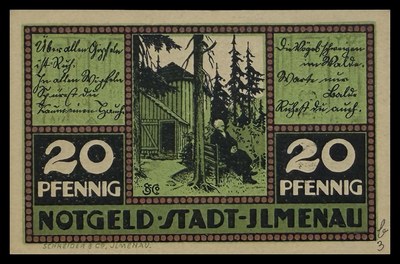
A wooden cabin or barn structure set in a forested mountain landscape with conifer trees, representing a traditional Thuringian Forest scene. The central vignette shows rustic mountain architecture characteristic of the Ilmenau region in Thuringia. Text panels on either side contain Gothic script inscriptions validating the note's acceptance by local merchants and authorities. This imagery evokes Ilmenau's identity as a gateway to the Thuringian Forest and its timber industry heritage.
Back
The coat of arms of Ilmenau, showing a shield quartered with a palm or tree motif in the upper section and mining hammers in the lower section, flanked by two tower structures representing the city's medieval fortifications. The heraldic design reflects Ilmenau's dual identity as both a mining town and a center of forestry. The back bears the date '11 JANUAR 1921' and validation text stating the note's official acceptance after stamping by the magistrate ('Die Gültigkeit erlischt nach Aufhuf').
History
This is an example of German Notgeld (emergency money) issued by the town of Ilmenau in Thuringia during the severe inflation and currency shortage following World War I. Ilmenau, located in the Thuringian Forest, issued numerous artistic Notgeld notes between 1921-1923, many featuring local scenes, folklore, and the town's association with Goethe, who frequented the area. These notes were typically printed by local firms such as Schreiber & Co. and circulated as small-denomination currency when official Reich coinage was hoarded. The Notgeld period ended with the introduction of the Rentenmark in November 1923, which stabilized the currency. Ilmenau's Notgeld series is well-documented among collectors of German emergency currency.
Linked specimens (1)
Merge into another type
Repoints every linked specimen above to the chosen target type, fills any target nulls from this type, then deletes this type. This cannot be undone.