Type details
| Country | Germany |
| Currency | Rentenmark |
| Denomination | 2 |
| Series | Rentenmark series |
| Series year | 1937 |
| Series range | 1923-1948 |
| Issue year | 1937 |
| Issuer | Deutsche Rentenbank |
| Issuer (native) | Deutsche Rentenbank |
| Printer | Reichsdruckerei |
| Reverse subject | Oak tree with acorns |
| Themes | agriculture,industry |
| Security features | guilloche_patterns,microprint |
| Colour palette | #8b7355,#4a4a3a,#d4b896 |
| Material | paper |
| Dimensions (mm) | 105x62 |
| Language / script | Latin (Fraktur/Gothic) |
| Languages | de |
| Pick # | P-175 |
| Rarity | common |
| Legal status | demonetized |
| Legal status date | 1948 |
| Predecessor currency | Papiermark |
| Successor currency | Deutsche Mark |
| Era | 1900_1945 |
| Default value (low) | 5.0 |
| Default value (high) | 15.0 |
| Value currency | USD |
Front
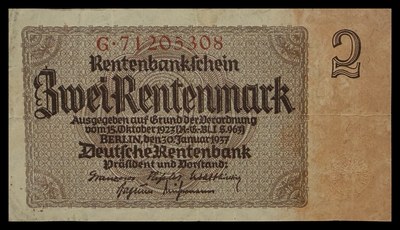
German Rentenbank 2 Rentenmark note issued on January 30, 1937. The Rentenmark was an emergency currency introduced in November 1923 to stabilize the German economy during the hyperinflation crisis of the Weimar Republic. Backed by land and industrial assets rather than gold, it successfully ended the hyperinflation and circulated alongside the Reichsmark until 1948. The note features elaborate guilloche patterns and Gothic blackletter typography with the text 'Rentenbankschein Zwei Rentenmark' (Rentenbank Note Two Rentenmarks) and legal tender declaration.
Back
Oak tree with acorns in a circular medallion at center, flanked by the numeral '2' on both sides. The oak tree is a traditional German national symbol representing strength, endurance, and steadfastness. The inscription 'Deutsche Rentenbank' appears at top in Fraktur typeface, with 'Zwei Rentenmark' (Two Rentenmarks) below the central design. The reverse reinforces the agricultural and natural resource backing that gave the Rentenmark its stability.
History
This note belongs to the Rentenmark series issued by the Deutsche Rentenbank from 1923-1948. The Rentenmark was created in November 1923 as an emergency currency to halt the catastrophic hyperinflation of the Weimar Republic, where the Papiermark had become virtually worthless. Unlike previous currency, the Rentenmark was notionally backed by mortgages on agricultural and industrial land (Rentenbrief bonds). The exchange rate was set at 1 Rentenmark = 1 trillion Papiermarks. Though intended as temporary, it circulated alongside the Reichsmark (introduced 1924) until both were replaced by the Deutsche Mark in 1948 after World War II. The 1937 issue represents the later period of Rentenmark circulation during the Nazi era.
Linked specimens (1)
Merge into another type
Repoints every linked specimen above to the chosen target type, fills any target nulls from this type, then deletes this type. This cannot be undone.