100 Mark #198
Reichsbanknote Series 1908
(1908–1914)
· issued 1908
· P-33
· common
Type details
| Country | Germany |
| Currency | Mark |
| Denomination | 100 |
| Series | Reichsbanknote Series 1908 |
| Series year | 1908 |
| Series range | 1908–1914 |
| Issue year | 1908 |
| Issuer | Reichsbank |
| Issuer (native) | Reichsbank |
| Signatures | Reichsbankdirektorium signatures |
| Printer | Reichsdruckerei |
| Front portrait | Germania (allegorical figure) |
| Reverse subject | German Imperial Eagle with crown |
| Themes | mythology,statesman |
| Watermark | Imperial German eagle in center field |
| Security features | intaglio,microprint |
| Colour palette | #4a6b7c,#d4c5a9,#8b4513 |
| Material | paper |
| Dimensions (mm) | 185x115 |
| Language / script | Latin with Fraktur (Gothic) typeface |
| Languages | de |
| Pick # | P-33 |
| Rarity | common |
| Legal status | demonetized |
| Legal status date | 1924 |
| Predecessor currency | Goldmark |
| Successor currency | Rentenmark |
| Era | 1900_1945 |
| Default value (low) | 15.0 |
| Default value (high) | 40.0 |
| Value currency | USD |
Front
Germania, the allegorical female personification of the German nation, shown in an ornate medallion at center. She is flanked by two allegorical female figures representing aspects of German virtue and prosperity. Germania was widely used on Imperial German banknotes and coins as a national symbol during the German Empire period (1871–1918), representing the unity and strength of the German nation. The neoclassical design reflects the artistic conventions of late Imperial Germany.
Back
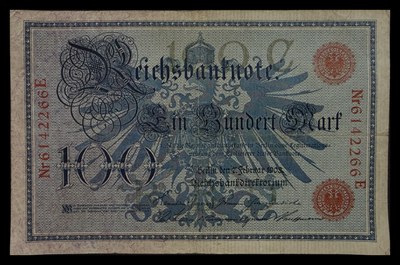
The German Imperial Eagle (Reichsadler) with crown, the heraldic symbol of the German Empire. The eagle holds an orb and scepter, traditional symbols of imperial authority. The text 'Reichsbanknote Einhundert Mark' (Reichsbank Note One Hundred Marks) is prominently displayed in ornate Gothic script. The note is dated Berlin, 7 February 1908, and bears the red seals of the Reichsbank with the Imperial Eagle. This design represents the authority of the German Empire under Kaiser Wilhelm II.
History
This is a 100 Mark Reichsbanknote from the 1908 series, issued by the Reichsbank during the German Empire period. These notes circulated from 1908 until the end of World War I and into the early Weimar Republic. The series was gradually withdrawn during the hyperinflation period of 1921–1923, when the Mark lost virtually all its value. The notes were formally demonetized in 1924 with the introduction of the Rentenmark and then the Reichsmark. The 1908 series is notable for its elaborate engraving and use of traditional German imperial symbolism, reflecting the confidence and stability of the pre-WWI German economy.
Linked specimens (2)

Merge into another type
Repoints every linked specimen above to the chosen target type, fills any target nulls from this type, then deletes this type. This cannot be undone.