100000 Reichsmark #200
Third Hyperinflation Issue
(1923–1924)
· issued 1923
· P-83
· common
Type details
| Country | Germany |
| Currency | Reichsmark |
| Denomination | 100000 |
| Series | Third Hyperinflation Issue |
| Series year | 1923 |
| Series range | 1923–1924 |
| Issue year | 1923 |
| Issuer | Reichsbanknote |
| Issuer (native) | Reichsbanknote |
| Signatures | Reichsbankdirektorium |
| Printer | Reichsdruckerei |
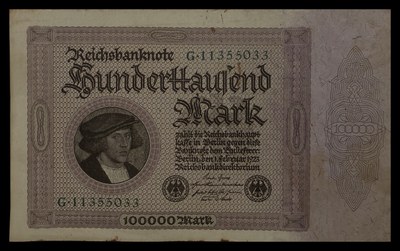
| Front portrait | Merchant or burgher figure |
| Reverse subject | Ornate geometric guilloche pattern |
| Themes | statesman,commemorative |
| Watermark | Geometric pattern |
| Security features | intaglio,microprint |
| Colour palette | #6b5d52,#4a4035,#8b7d6b |
| Material | paper |
| Dimensions (mm) | 150x105 |
| Language / script | Fraktur |
| Languages | de |
| Pick # | P-83 |
| Rarity | common |
| Legal status | demonetized |
| Legal status date | 1924 |
| Predecessor currency | Papiermark |
| Successor currency | Rentenmark |
| Era | 1900_1945 |
| Default value (low) | 5.0 |
| Default value (high) | 15.0 |
| Value currency | USD |
Front
Portrait of a merchant or burgher in Renaissance-era dress and cap, representing the German middle class and commercial tradition. The figure embodies the economic history of Germany during a period of catastrophic hyperinflation in 1923, when the Reichsmark lost virtually all value and such enormous denominations became necessary for daily transactions. The Weimar Republic issued notes in astronomical denominations as inflation spiraled out of control, with 100,000 Mark notes becoming commonplace before the currency reform.
Back
Ornate geometric guilloche pattern with the denomination 100000 Mark repeated in ornamental frames. The reverse design uses intricate line work and rosette patterns as anti-counterfeiting measures, though the rapid printing requirements during hyperinflation meant security features were often simplified. The text 'Reichsbanknote' appears in decorative script within the pattern work.
History
This 100,000 Mark note was issued during the catastrophic German hyperinflation of 1923, one of the most extreme episodes of currency devaluation in modern history. By late 1923, the Reichsmark had become essentially worthless, with prices doubling every few days. The Reichsbank printed notes in ever-larger denominations—millions, billions, and eventually trillions of Marks—to keep pace with inflation caused by war reparations, economic disruption, and the Ruhr occupation. This series was replaced by the Rentenmark in November 1923 at a rate of 1 Rentenmark = 1 trillion Papiermark, stabilizing the German economy. These hyperinflation notes remain common today as historical artifacts of economic catastrophe.
Linked specimens (1)
Merge into another type
Repoints every linked specimen above to the chosen target type, fills any target nulls from this type, then deletes this type. This cannot be undone.