Type details
| Country | Greece |
| Currency | Drachma |
| Denomination | 20 |
| Series | Issue of 1940-1944 |
| Series year | 1941 |
| Series range | 1940–1944 |
| Issue year | 1941 |
| Issuer | Bank of Greece |
| Issuer (native) | ΤΡΑΠΕΖΑ ΤΗΣ ΕΛΛΑΔΟΣ |
| Signatures | Governor: Emmanouil Tsouderos; Minister of Finance |
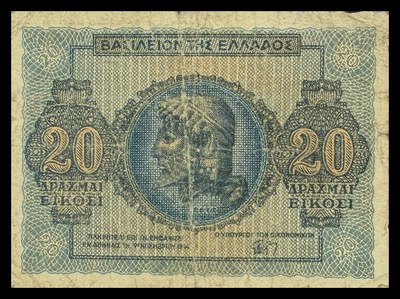
| Front portrait | Athena |
| Reverse subject | Seated figure with pottery |
| Themes | mythology,indigenous_culture |
| Watermark | None visible |
| Security features | guilloche_patterns,microprint |
| Colour palette | #d4c5a0,#4a6b5c,#1a1a1a |
| Material | paper |
| Dimensions (mm) | 120x65 |
| Language / script | Greek |
| Languages | el |
| Pick # | 315 |
| Rarity | common |
| Legal status | demonetized |
| Legal status date | 1944 |
| Predecessor currency | Drachma |
| Successor currency | Drachma (revalued) |
| Era | 1900_1945 |
| Default value (low) | 3.0 |
| Default value (high) | 10.0 |
| Value currency | USD |
Front
Athena, the ancient Greek goddess of wisdom, warfare, and patron deity of Athens, depicted in profile wearing her characteristic crested helmet. Athena was the most revered deity of Athens and appears frequently on Greek currency as a symbol of wisdom, strength, and Hellenic cultural heritage. The note features ornate guilloche patterns and the denomination '20 ΔΡΑΧΜΑΙ ΕΙΚΟΣΙ' (20 Drachmai Twenty) flanking the goddess.
Back
A seated classical Greek figure, likely representing an artisan or potter, working with ceramic vessels—symbolizing Greek craftsmanship and the nation's ancient cultural achievements in pottery and ceramics. The scene evokes Greece's renowned tradition of pottery-making from antiquity, when Greek ceramic art was traded throughout the Mediterranean. The text 'ΔΡΑΧΜΑΙ ΕΙΚΟΣΙ' (Drachmai Twenty) appears at the bottom.
History
This 20 Drachma note was issued during WWII by the Bank of Greece during the Axis occupation period (1940–1944). The series circulated during one of the most difficult periods in modern Greek history, marked by severe economic disruption, inflation, and hardship under German, Italian, and Bulgarian occupation. These wartime issues were eventually withdrawn and replaced as Greece stabilized its currency after liberation in 1944. The design draws heavily on classical Greek iconography to assert national identity during occupation.
Linked specimens (1)
Merge into another type
Repoints every linked specimen above to the chosen target type, fills any target nulls from this type, then deletes this type. This cannot be undone.