Type details
| Country | Greece |
| Currency | GRD |
| Denomination | 1000000 |
| Series | 1944 Inflation Issue |
| Series year | 1944 |
| Series range | 1944–1944 |
| Issue year | 1944 |
| Issuer | Bank of Greece |
| Issuer (native) | ΤΡΑΠΕΖΑ ΤΗΣ ΕΛΛΑΔΟΣ |
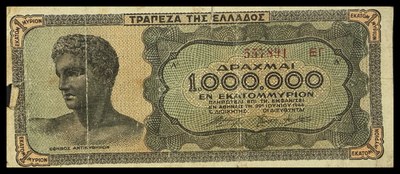
| Front portrait | Ephebe of Antikythera |
| Reverse subject | Temple of Poseidon at Sounion |
| Themes | mythology,architecture |
| Security features | intaglio |
| Colour palette | #c4a573,#4a6b5a,#8b7355 |
| Material | paper |
| Dimensions (mm) | 175x82 |
| Language / script | Greek |
| Languages | el |
| Pick # | P-127 |
| Rarity | common |
| Legal status | demonetized |
| Legal status date | 1944 |
| Predecessor currency | Drachma |
| Successor currency | New Drachma (1944 revaluation) |
| Era | 1900_1945 |
| Default value (low) | 1.0 |
| Default value (high) | 5.0 |
| Value currency | USD |
Front
The Ephebe of Antikythera (Ἔφηβος Ἀντικυθήρων), a bronze statue recovered from the Antikythera shipwreck in 1900, dating to circa 340–330 BC. The sculpture, now housed in the National Archaeological Museum of Athens, is believed to represent either Paris or Perseus. The inscription 'ΕΦΗΒΟΣ ΑΝΤΙΚΥΘΗΡΩΝ' (Ephebe of Antikythera) appears below the portrait. The note is dated 29 June 1944 during the German occupation hyperinflation period.
Back
The Temple of Poseidon at Cape Sounion, built circa 444–440 BC during the Age of Pericles. This Doric temple overlooks the Aegean Sea at the southernmost tip of Attica and remains one of Greece's most significant ancient monuments. The inscription 'ΣΟΥΝΙΟΝ-ΝΑΟΣ ΠΟΣΕΙΔΩΝΟΣ' (Sounion – Temple of Poseidon) identifies the scene. 'ΕΚΔΟΣΙΣ ΠΡΩΤΗ' (First Issue) appears at bottom.
History
This 1,000,000 drachmai note was issued on 29 June 1944 during the catastrophic hyperinflation of the Greek occupation by Axis powers in World War II. The German occupation authorities forced the Bank of Greece to finance occupation costs, leading to one of history's worst hyperinflations. By November 1944, prices were doubling every 4.3 days. This note, despite its million-drachma face value, was nearly worthless by late 1944. A currency reform in November 1944 exchanged 50 billion old drachmai for one new drachma.
Linked specimens (1)
Merge into another type
Repoints every linked specimen above to the chosen target type, fills any target nulls from this type, then deletes this type. This cannot be undone.