Type details
| Country | Greece |
| Currency | GRD |
| Denomination | 5000 |
| Series | Occupation issue |
| Series range | 1942–1944 |
| Issue year | 1942 |
| Issuer | Bank of Greece |
| Issuer (native) | ΤΡΑΠΕΖΑ ΤΗΣ ΕΛΛΑΔΟΣ |
| Signatures | Governor: X. Zolotas; Director: D. N. Nomicos |
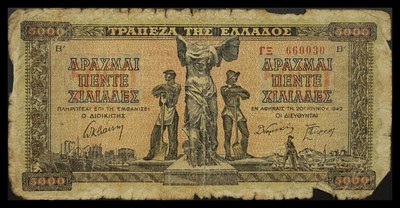
| Front portrait | Nike of Samothrace |
| Reverse subject | Agricultural scene with farmers |
| Themes | agriculture,mythology |
| Watermark | None |
| Security features | intaglio |
| Colour palette | #d4a574,#8b7355,#2f2f2f |
| Material | paper |
| Language / script | Greek |
| Languages | el |
| Pick # | P-119 |
| Rarity | common |
| Legal status | demonetized |
| Legal status date | 1944 |
| Predecessor currency | Greek Drachma |
| Successor currency | Greek Drachma (revalued) |
| Era | 1900_1945 |
| Default value (low) | 5.0 |
| Default value (high) | 15.0 |
| Value currency | USD |
Front
Nike of Samothrace (Winged Victory), the ancient Greek marble sculpture from circa 200–190 BCE now housed in the Louvre Museum. This Hellenistic masterpiece, discovered on the island of Samothrace in 1863, depicts the goddess Nike and is one of the most celebrated works of ancient Greek art. She appears at center flanked by two classical male figures, with industrial vignettes (factory and port scenes) at lower corners representing modern Greek economic activity.
Back
Agricultural scene depicting Greek farmers at work in the fields with oxen-drawn plows, surrounded by sheaves of wheat and agricultural implements. The scene symbolizes Greece's rural economy and agricultural heritage, with decorative plant motifs (wheat sheaves and palm fronds) in the corners emphasizing the theme of productivity and harvest.
History
This 5,000 drachma note was issued by the Bank of Greece during the Axis occupation of Greece in World War II (1942). The date on the note, 20 June 1942 (ΕΝ ΑΘΗΝΑΙΣ ΤΗ 20 ΙΟΥΝΙΟΥ 1942), places it during the period of severe hyperinflation that devastated the Greek economy under occupation. The German and Italian occupiers forced the Bank of Greece to print massive quantities of currency to finance occupation costs, causing the drachma to collapse in value. By 1944, notes reached denominations in the billions. This series was withdrawn and demonetized after liberation in 1944, when Greece introduced currency reforms to stabilize the economy. The juxtaposition of classical Greek imagery (Nike) with modern industrial and agricultural scenes reflects an attempt to maintain national identity and continuity during occupation.
Linked specimens (1)
Merge into another type
Repoints every linked specimen above to the chosen target type, fills any target nulls from this type, then deletes this type. This cannot be undone.