50 Peso #231
Post-independence Peso series
(1990–1997)
· issued 1990
· P-11
· scarce
Type details
| Country | Guinea-Bissau |
| Currency | Peso |
| Denomination | 50 |
| Series | Post-independence Peso series |
| Series year | 1990 |
| Series range | 1990–1997 |
| Issue year | 1990 |
| Issuer | Banco Central da Guiné-Bissau |
| Issuer (native) | Banco Central da Guiné-Bissau |
| Signatures | Ministro Governador; Vice Governador |
| Printer | Thomas De La Rue and Company, Limited |
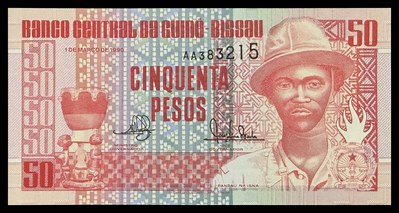
| Front portrait | Pansau Na Isna |
| Reverse subject | Traditional village scene with artisans and craftspeople |
| Themes | indigenous_culture,agriculture,industry,commemorative |
| Watermark | Portrait of woman in traditional headdress in clear field at right |
| Security features | watermark,see_through_register,intaglio |
| Colour palette | #8b3a3a,#d4af7a,#9bbc9f |
| Material | paper |
| Dimensions (mm) | 160x80 |
| Language / script | Latin |
| Languages | pt |
| Pick # | P-11 |
| Rarity | scarce |
| Legal status | demonetized |
| Legal status date | 1997 |
| Predecessor currency | Escudo |
| Successor currency | CFA Franc BCEAO |
| Era | 1990_present |
| Default value (low) | 5.0 |
| Default value (high) | 15.0 |
| Value currency | USD |
Front
Pansau Na Isna, a symbolic representation of Guinea-Bissau national identity and indigenous culture. The name means 'Our People' in Creole and represents the collective spirit of the nation's diverse ethnic groups. The portrait shows a woman in traditional headdress and jewelry, symbolizing the cultural heritage and strength of Guinea-Bissau's people. The note was issued during the period when Guinea-Bissau used its own peso currency before joining the West African CFA franc zone.
Back
Traditional village scene depicting artisans and craftspeople engaged in daily economic activities including pottery making, grain pounding, and agricultural work. The scene celebrates the traditional economy and cultural practices of Guinea-Bissau's rural communities, showing figures working with traditional tools and engaged in subsistence activities that formed the backbone of the nation's economy. The imagery emphasizes indigenous culture and the dignity of labor in traditional African society.
History
This note belongs to the post-independence Peso series issued by Guinea-Bissau between 1990 and 1997, following the country's independence from Portugal in 1974. The Peso was the national currency until 1997, when Guinea-Bissau joined the West African Economic and Monetary Union (WAEMU) and adopted the CFA Franc BCEAO. The 1990 series featured imagery celebrating national identity, indigenous culture, and traditional economic activities. The date '1 DE MARÇO DE 1990' (March 1, 1990) appears on the note. These notes were demonetized upon the currency changeover in 1997.
Linked specimens (1)
Merge into another type
Repoints every linked specimen above to the chosen target type, fills any target nulls from this type, then deletes this type. This cannot be undone.