Type details
| Country | Guinea |
| Currency | Guinean Franc |
| Denomination | 100 |
| Series | First Republic issue |
| Series year | 1960 |
| Series range | 1960–1971 |
| Issue year | 1960 |
| Issuer | Banque Centrale de la République de Guinée |
| Issuer (native) | Banque Centrale de la République de Guinée |
| Signatures | Ministre des Finances: [signature]; Gouverneur Banque Centrale: [signature] |
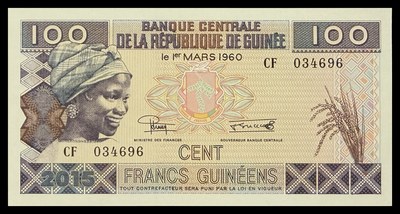
| Front portrait | Guinean woman in traditional headwrap |
| Reverse subject | Village scene with banana trees and traditional huts |
| Themes | indigenous_culture,agriculture,architecture |
| Watermark | Elephant in a clear field at left |
| Security features | intaglio,microprint |
| Colour palette | #d4b896,#8b7355,#e8d5b7 |
| Material | paper |
| Dimensions (mm) | 160x85 |
| Language / script | Latin |
| Languages | fr |
| Pick # | P-15 |
| Rarity | scarce |
| Legal status | demonetized |
| Legal status date | 1971 |
| Predecessor currency | French West African franc |
| Successor currency | Syli |
| Era | 1946_1989 |
| Default value (low) | 15.0 |
| Default value (high) | 40.0 |
| Value currency | USD |
Front
Portrait of a Guinean woman in traditional dress with elaborate headwrap, representing the newly independent nation's cultural identity. Guinea gained independence from France on October 2, 1958, under President Ahmed Sékou Touré, and issued its first national currency in 1960, replacing the French West African franc. The note bears the date 'le 1er MARS 1960' marking the introduction of the Guinean franc. The coat of arms features an elephant with the word 'JUSTICE', symbolizing the republic's ideals. The denomination '100 FRANCS GUINÉENS' appears prominently, with geometric patterns and a rice stalk motif representing agriculture.
Back
Traditional Guinean village scene with banana trees, palm trees, and conical-roofed huts, depicting rural life and the agricultural foundation of the newly independent nation. The scene represents Guinea's primary economic activities in the early independence period, with tropical vegetation including banana plants prominent in the composition. Decorative borders feature traditional African geometric patterns in multiple colors.
History
This note belongs to the first national currency series issued by the Republic of Guinea following independence from France in 1958. The Guinean franc was introduced on March 1, 1960, to replace the French West African franc at par. Under President Ahmed Sékou Touré's government, Guinea pursued an independent economic path, breaking with the French monetary union. This series circulated until 1971, when it was replaced by the Syli at a rate of 10 francs = 1 syli as part of Guinea's adoption of a decimal monetary system. The imagery on these notes emphasized national pride, African cultural identity, and agricultural development themes central to the post-independence nation-building project.
Linked specimens (1)
Merge into another type
Repoints every linked specimen above to the chosen target type, fills any target nulls from this type, then deletes this type. This cannot be undone.