Type details
| Country | Ecuador |
| Currency | Sucre |
| Denomination | 10 |
| Series range | 1977–1981 |
| Issue year | 1977 |
| Issuer | Banco Central del Ecuador |
| Signatures | Gerente General: [signature illegible]; Superintendente de Bancos: [signature illegible]; Vocal: [signature illegible] |
| Printer | American Bank Note Company |
| Front portrait | Sebastián de Belalcázar |
| Reverse subject | Coat of arms of Ecuador |
| Themes | military,statesman |
| Watermark | None |
| Security features | microprint,intaglio |
| Colour palette | #d4b896,#2d5f8d,#1a1a1a |
| Material | paper |
| Dimensions (mm) | 156x67 |
| Language / script | Latin |
| Languages | es |
| Pick # | 121 |
| Rarity | common |
| Legal status | demonetized |
| Legal status date | 2000 |
| Successor currency | United States Dollar |
| Era | 1946_1989 |
| Default value (low) | 5.0 |
| Default value (high) | 15.0 |
| Value currency | USD |
Front
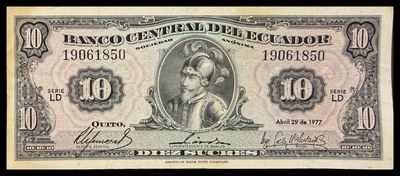
Sebastián de Belalcázar (c. 1480–1551), Spanish conquistador who founded Quito in 1534 and served as its first governor. He played a major role in the Spanish conquest of Ecuador and was instrumental in establishing Spanish rule in the northern Andes. His portrait appears in an oval frame at center, wearing period armor and a plumed helmet, symbolizing his historical significance to Ecuador's colonial foundation.
Back
The coat of arms of Ecuador at center, featuring the national shield with Mount Chimborazo, a steamship on the Guayas River, a sun in the upper portion, and four flags representing the four original provinces. The condor perched atop the shield holds a band with the inscription 'ECUADOR'. This design represents Ecuador's geography, independence, and national identity.
History
This note was issued on April 29, 1977 (Serie LD) during Ecuador's use of the Sucre, the national currency from 1884 to 2000. The Sucre was named after Antonio José de Sucre, the independence hero and first president. Ecuador experienced multiple currency reforms and significant inflation during the late 20th century, ultimately replacing the Sucre with the U.S. Dollar in 2000 during a severe economic crisis. The American Bank Note Company printed many Ecuadorian notes during this period.
Linked specimens (1)
Merge into another type
Repoints every linked specimen above to the chosen target type, fills any target nulls from this type, then deletes this type. This cannot be undone.