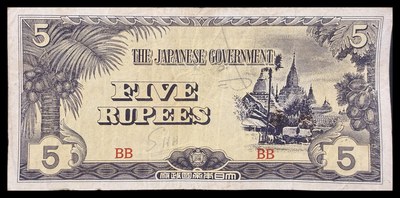
Type details
| Country | Burma |
| Currency | Burmese rupee |
| Denomination | 5 Rupees |
| Series | Japanese Occupation Issue |
| Series range | 1942–1945 |
| Issuer | Japanese Government (occupying authority in Burma) |
| Issuer (native) | 日本政府 |
| Reverse subject | Borobudur temple complex |
| Themes | architecture,religion,military |
| Security features | guilloche_patterns |
| Colour palette | #8b7355,#d3c5a8,#4a4a4a |
| Material | paper |
| Language / script | Latin, Japanese |
| Languages | en,ja |
| Pick # | M4 |
| Rarity | common |
| Legal status | demonetized |
| Legal status date | 1945 |
| Predecessor currency | Indian rupee |
| Successor currency | Burmese rupee (post-independence) |
| Era | 1900_1945 |
| Default value (low) | 5.0 |
| Default value (high) | 15.0 |
| Value currency | USD |
Front
Ornate guilloche patterns forming decorative panels with the denomination ½ displayed prominently in mirror image on both sides. This is the obverse of a Japanese occupation note issued during World War II when Imperial Japanese forces occupied Burma (1942–1945). The minimalist design reflects emergency wartime printing conditions.
Back
Borobudur, the 9th-century Mahayana Buddhist temple complex in Central Java, Indonesia — one of the world's largest Buddhist monuments. The depiction shows the distinctive stupas and multi-tiered structure of this UNESCO World Heritage site. Japanese occupation currency frequently featured Buddhist and Hindu temples from Southeast Asia to promote pan-Asian solidarity under Japanese rule. Text reads 'THE JAPANESE GOVERNMENT' with denomination 'FIVE RUPEES' and block letters 'BB' in red. Japanese characters appear at the bottom.
History
Japanese Invasion Money (JIM) issued for Burma during World War II occupation (1942–1945). Following Japan's conquest of Burma in 1942, the Imperial Japanese government issued military scrip denominated in rupees to replace the Indian rupee that had circulated under British rule. These notes, printed in large quantities, contributed to hyperinflation in occupied territories. The 'BB' block letters likely indicate a series or print run identifier. The use of Borobudur (located in Java, not Burma) reflects Japanese propaganda emphasizing Buddhist heritage across the Greater East Asia Co-Prosperity Sphere. These notes were demonetized immediately upon Japanese surrender in 1945 and hold primarily historical and collectible interest today. Pick catalog references for Japanese occupation notes use the 'M' prefix (Military).