Type details
| Country | Nepal |
| Currency | Nepalese Rupee |
| Denomination | 1 |
| Issuer | Nepal Rastra Bank |
| Issuer (native) | नेपाल राष्ट्र बैंक |
| Front portrait | King Mahendra |
| Reverse subject | Singha Durbar |
| Themes | monarch,architecture |
| Security features | guilloche,microprint |
| Colour palette | #2d5f3f,#f5f0e8,#1a1a1a |
| Material | paper |
| Language / script | Devanagari |
| Languages | ne |
| Pick # | 8 |
| Rarity | common |
| Legal status | demonetized |
| Era | 1946_1989 |
| Default value (low) | 2.0 |
| Default value (high) | 8.0 |
| Value currency | USD |
Front
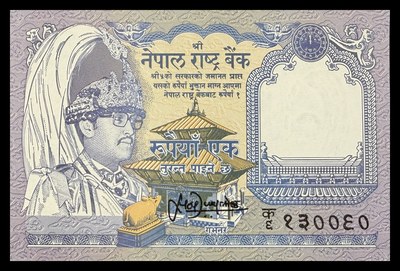
One Rupee note of Nepal featuring geometric guilloche patterns and ornamental design typical of early Nepalese currency. The denomination '1' appears prominently at center within an ornate frame with scrollwork and traditional Nepali decorative elements in the corners.
Back
King Mahendra Bir Bikram Shah Dev (1920–1972), the ninth King of Nepal who ruled from 1955 to 1972, depicted in profile wearing glasses and traditional cap. He is remembered for introducing the Panchayat system of governance and modernizing Nepal's infrastructure. The note also features Singha Durbar, the grand neoclassical palace complex in Kathmandu that serves as the seat of the Government of Nepal, built in 1908 by Rana Prime Minister Chandra Shumsher. The palace name appears in Devanagari script along with 'Nepal Rastra Bank' at top.
History
This is a One Rupee note issued by Nepal Rastra Bank during King Mahendra's reign (1955–1972). The serial number '१२३००२०' is printed in Devanagari numerals. This series represents the early post-monarchy establishment period when Nepal was modernizing its currency system under the Nepal Rastra Bank, which was established in 1956. The note features traditional Nepali architectural and royal imagery. Based on the design style, portrait of King Mahendra, and the Devanagari serial numbering system, this note likely dates from the 1960s period. King Mahendra's image appeared on Nepalese currency throughout his reign until his death in 1972.
Linked specimens (1)
Merge into another type
Repoints every linked specimen above to the chosen target type, fills any target nulls from this type, then deletes this type. This cannot be undone.