Type details
| Country | Pakistan |
| Currency | PKR |
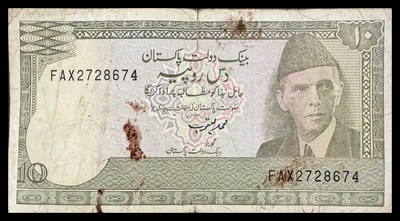
| Denomination | 10 Rupees |
| Series range | 1976-1984 |
| Issuer | State Bank of Pakistan |
| Issuer (native) | بینک دولت پاکستان |
| Front portrait | Muhammad Ali Jinnah |
| Reverse subject | Mohenjo-daro archaeological site |
| Themes | statesman,architecture,indigenous_culture |
| Watermark | Muhammad Ali Jinnah portrait |
| Security features | watermark,intaglio |
| Colour palette | #8b7d6b,#d4c5a9,#5a6b4d |
| Material | paper |
| Dimensions (mm) | 157x65 |
| Language / script | Latin, Urdu (Nastaliq) |
| Languages | en,ur |
| Pick # | 28 |
| Rarity | common |
| Legal status | demonetized |
| Era | 1946_1989 |
| Default value (low) | 1.0 |
| Default value (high) | 3.0 |
| Value currency | USD |
Front
Mohenjo-daro, one of the major cities of the ancient Indus Valley Civilization (circa 2500–1900 BCE), located in Sindh province, Pakistan. The ruins represent one of the earliest major urban settlements in the world and a UNESCO World Heritage Site; the depiction shows the Great Bath and residential structures of this Bronze Age city, emphasizing Pakistan's ancient cultural heritage.
Back
Muhammad Ali Jinnah (1876–1948), founder of Pakistan and its first Governor-General, widely known as Quaid-e-Azam (Great Leader). A barrister and statesman who led the All-India Muslim League and the Pakistan Movement, achieving the creation of Pakistan as an independent nation in 1947; he is the most honoured figure in Pakistani history and appears on all denominations of Pakistani currency.
History
This note belongs to the State Bank of Pakistan series issued from 1976 to 1984 following the 1971 redesign that removed Bengali script after the independence of Bangladesh. The design features the iconic pairing of Jinnah's portrait (present on all Pakistani banknotes) with Mohenjo-daro on the 10 rupee denomination, linking Pakistan's modern foundation to its ancient Indus Valley heritage. The serial prefix 'FAX' indicates this is from a later printing within the series run. These notes were gradually withdrawn from circulation in the 1980s and replaced by subsequent series with updated security features.
Linked specimens (1)
Merge into another type
Repoints every linked specimen above to the chosen target type, fills any target nulls from this type, then deletes this type. This cannot be undone.