Type details
| Country | Peru |
| Currency | Peruvian Inti |
| Denomination | 500 Intis (front) / 20 Pesos (back) |
| Series range | 1985–1991 |
| Issuer | Banco Central de Reserva del Perú (front) |
| Issuer (native) | BANCO CENTRAL DE RESERVA DEL PERÚ |
| Printer | Bundesdruckerei (visible on front) |
| Reverse subject | Peruvian Andes |
| Themes | agriculture,indigenous_culture,architecture |
| Watermark | Portrait of Túpac Amaru II |
| Security features | microprint,intaglio |
| Colour palette | #d4af37,#8b7355,#f5deb3 |
| Material | paper |
| Language / script | Latin |
| Languages | es,en |
| Legal status | demonetized |
| Legal status date | 1991 |
| Predecessor currency | Sol |
| Successor currency | Nuevo Sol |
| Era | 1990_present |
Front
Andean mountain scene depicting traditional highland agriculture in Peru, with snow-capped peaks (likely Cordillera Blanca or similar Andean range), terraced fields, livestock (llamas or alpacas), and indigenous farmers working the land. The imagery represents the agricultural heritage and indigenous culture of the Peruvian highlands. The denomination '500 INTIS' is prominent, issued by the Banco Central de Reserva del Perú. The Inti was Peru's currency from 1985–1991, replacing the Sol de Oro during a period of severe hyperinflation. The stylized Pre-Columbian deity motif at upper left reflects Peru's rich archaeological heritage.
Back
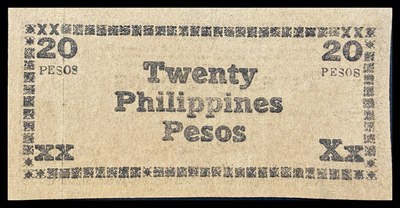
Text reading 'Twenty Philippines Pesos' with '20 PESOS' denominations in corners and decorative border pattern. This reverse does NOT match the Peruvian Inti note shown on the front — it appears to be from a Philippine 20 Pesos emergency or guerrilla currency note, likely from the Japanese Occupation period (1942–1945) or a similar emergency issue. The simple typography and basic printing are characteristic of wartime emergency currency.
History
MISMATCHED PAIR: The front and back images do NOT belong to the same banknote. The front is a Peruvian 500 Intis note from the Inti series (1985–1991), which replaced the Sol de Oro at 1,000:1 during hyperinflation and was itself replaced by the Nuevo Sol in 1991. The Inti notes featured Andean cultural and agricultural themes. The back image is a Philippine 20 Pesos note, most likely emergency currency from WWII Japanese Occupation (1942–1945) or similar period, characterized by simple printing and basic security features. These two notes are from entirely different countries, currencies, and historical periods. No serial number is visible on either image. Printer marking 'Bundesdruckerei' on front indicates German printing.
Linked specimens (1)
Merge into another type
Repoints every linked specimen above to the chosen target type, fills any target nulls from this type, then deletes this type. This cannot be undone.