Type details
| Country | Philippines |
| Currency | PHP |
| Denomination | 2 Piso |
| Series | Ang Bagong Lipunan Series |
| Series range | 1973-1985 |
| Issuer | Bangko Sentral ng Pilipinas |
| Themes | commemorative,indigenous_culture |
| Security features | microprint,intaglio |
| Colour palette | #f5deb3,#4169e1,#90ee90 |
| Material | paper |
| Dimensions (mm) | 160x66 |
| Language / script | Latin |
| Languages | tl,en |
| Legal status | demonetized |
| Legal status date | 1993 |
| Predecessor currency | Philippine Peso (English series) |
| Successor currency | New Design Series |
| Era | 1946_1989 |
Front
The Balconahe ng Mangunsong Aguinaldo (Balcony of Emilio Aguinaldo's house), depicting the historic moment when the independence of the Philippines was proclaimed on June 12, 1898. The note's inscription reads 'PAHAYAG NG KASARINLAN NG PILIPINAS NOONG HUNYO 12, 1898 (BALKONAHE NG MANSIONG AGUINALDO)', commemorating the centennial of Philippine independence. The scene shows figures on the iconic balcony in Kawit, Cavite, where Aguinaldo declared freedom from Spanish colonial rule, a pivotal moment in Philippine history that established the First Philippine Republic.
Back
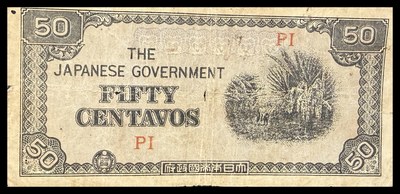
Japanese Government-issued occupation currency overprint reading 'THE JAPANESE GOVERNMENT FIFTY CENTAVOS' with 'PI' markings, depicting tropical vegetation including palm trees and other Philippine flora. This represents Japanese-issued invasion money (JIM) circulated during the occupation of the Philippines from 1942-1945 during World War II. The overprint on Philippine currency was part of Japan's wartime monetary control, which led to severe hyperinflation and economic disruption. These notes became worthless after liberation and are historical artifacts of the wartime occupation period.
History
This is a mismatched pair. The front is from a 2-Peso note from the Ang Bagong Lipunan series issued by the Central Bank of the Philippines (later Bangko Sentral ng Pilipinas) between 1973-1985, specifically a commemorative design celebrating the centennial of the proclamation of Philippine independence (1896-1996). The back, however, shows a Japanese occupation 50-centavo note from World War II (1942-1945), part of the invasion money issued during Japan's military occupation. These two notes are from completely different historical periods and issuers and do not form a legitimate front-back pair. The Philippine independence centennial series was issued in the 1990s, while the Japanese occupation currency was issued during WWII. The condition of both appears to be circulated with visible wear and staining.
Linked specimens (1)
Merge into another type
Repoints every linked specimen above to the chosen target type, fills any target nulls from this type, then deletes this type. This cannot be undone.