5 pesos Philippine peso #422
Japanese Occupation issue
(1942–1945)
· P-109a
· common
Type details
| Country | Philippines |
| Currency | Philippine peso |
| Denomination | 5 pesos |
| Series | Japanese Occupation issue |
| Series range | 1942–1945 |
| Issuer | Japanese Military Administration of the Philippines |
| Issuer (native) | 大日本帝國政府 |
| Reverse subject | Rizal Monument |
| Themes | military,architecture,commemorative |
| Colour palette | #d4c5a0,#4a5f6b,#1a1a1a |
| Material | paper |
| Language / script | Latin, Japanese |
| Languages | en,ja,tl |
| Pick # | P-109a |
| Rarity | common |
| Legal status | demonetized |
| Legal status date | 1945 |
| Predecessor currency | Commonwealth peso |
| Successor currency | Commonwealth peso (restored) |
| Era | 1900_1945 |
| Default value (low) | 5.0 |
| Default value (high) | 15.0 |
| Value currency | USD |
Front
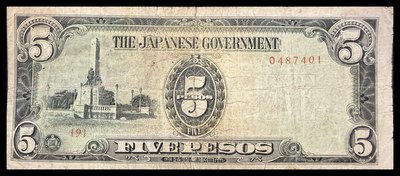
Generic ornamental frame design with denomination 'ONE PESO' at center and corner numerals '1'. The front features elaborate scrollwork and guilloche patterns in blue-green ink but no portrait. This minimalist design was typical of Japanese occupation currency issued rapidly during World War II.
Back
The Rizal Monument (Monumento kay Rizal) in Manila's Luneta Park (now Rizal Park), erected in 1913 to honor Dr. José Rizal, Philippine national hero executed by the Spanish in 1896. The monument, designed by Swiss sculptor Richard Kissling, marks the site where Rizal was executed and became the symbolic heart of Philippine nationalism. Inscription reads 'THE JAPANESE GOVERNMENT' with denomination 'FIVE PESOS' and serial number 0487401 in red.
History
Japanese Occupation currency for the Philippines, Series issued 1942–1945 during World War II following the Japanese invasion and occupation of the Philippine Islands. These invasion notes, often called 'Mickey Mouse money' by Filipinos due to their rapid devaluation and poor quality, were printed by the Japanese Military Administration to replace the Commonwealth peso. The bilingual inscription 'THE JAPANESE GOVERNMENT' (English) and Japanese characters reflected Japanese military authority. These notes became nearly worthless by 1944 due to hyperinflation caused by massive overprinting to fund the occupation. All Japanese occupation currency was demonetized when the Philippines was liberated by Allied forces in 1945. The note's condition and heavy circulation wear are typical of these wartime emergency issues. The reversal of denominations (front shows '1 PESO' while back shows 'FIVE PESOS') suggests this may be a mismatched pair, though some sources document multi-denomination overprints during the chaotic final months of occupation.
Linked specimens (1)
Merge into another type
Repoints every linked specimen above to the chosen target type, fills any target nulls from this type, then deletes this type. This cannot be undone.