Type details
| Country | Burundi |
| Currency | BIF |
| Denomination | 20 |
| Series | 1991 issue |
| Series range | 1991–1997 |
| Issue year | 1991 |
| Issuer | Banque de la République du Burundi |
| Issuer (native) | Ibanki ya Republika y'Uburundi |
| Signatures | Le Gouverneur: (signature); L'Administrateur: (signature) |
| Reverse subject | Coat of arms of Burundi |
| Themes | indigenous_culture,agriculture |
| Watermark | Coat of arms of Burundi in clear field |
| Security features | microprint,intaglio |
| Colour palette | #d4886c,#f5deb3,#8fbc8f |
| Material | paper |
| Dimensions (mm) | 140x70 |
| Language / script | Latin |
| Languages | fr,rn |
| Pick # | P-27b |
| Rarity | common |
| Legal status | demonetized |
| Legal status date | 2009 |
| Era | 1990_present |
| Default value (low) | 2.0 |
| Default value (high) | 5.0 |
| Value currency | USD |
Front
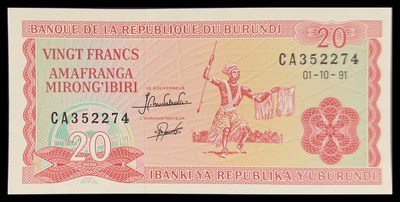
Traditional Burundian drummer in ceremonial dress, performing with a royal drum (karyenda). The drummer represents Burundi's rich cultural heritage where royal drums were sacred symbols of kingship and used in coronation ceremonies and important state occasions. The traditional attire and the ceremonial performance reflect the deep significance of drumming in Burundian culture, which has been recognized by UNESCO as intangible cultural heritage.
Back
National coat of arms of Burundi featuring a shield with the head of a lion, three spears behind it, and the national motto 'UNITE - TRAVAIL - PROGRES' (Unity, Work, Progress) on a ribbon below. The motto appears in French ('UNITE TRAVAIL PROGRES') with 'IBIKORWA AMAJAMBERE' visible in Kirundi, representing the nation's commitment to these founding principles. The coat of arms symbolizes sovereignty and national identity.
History
This note is from the 1991 issue series of the Burundian franc, printed during a transitional period in Burundi's history. The date 01-10-91 indicates October 1, 1991. This series continued to be issued through the 1990s and was eventually replaced by newer designs in the 2000s. The bilingual inscriptions in French and Kirundi reflect Burundi's official language policy. The traditional drummer motif was chosen to honor Burundi's cultural heritage, particularly the sacred royal drums (ingoma) that were central to the monarchy before it was abolished in 1966.
Linked specimens (1)
Merge into another type
Repoints every linked specimen above to the chosen target type, fills any target nulls from this type, then deletes this type. This cannot be undone.