Type details
| Country | United Kingdom |
| Currency | GBP |
| Denomination | 10 Shillings |
| Series | Britannia Series |
| Series year | 1940 |
| Series range | 1940–1948 |
| Issuer | Bank of England |
| Signatures | Chief Cashier: K.O. Peppiatt |
| Printer | Bank of England Printing Works |
| Front portrait | Britannia |
| Themes | mythology,statesman |
| Watermark | Helmeted Britannia head |
| Security features | watermark,intaglio |
| Colour palette | #c4a882,#8b7355,#4a4a6a |
| Material | paper |
| Dimensions (mm) | 151x85 |
| Language / script | Latin |
| Languages | en |
| Pick # | P-366 |
| Rarity | common |
| Legal status | demonetized |
| Legal status date | 1971-02-15 |
| Successor currency | Decimal Pound Sterling |
| Era | 1900_1945 |
| Default value (low) | 5.0 |
| Default value (high) | 15.0 |
| Value currency | GBP |
Front
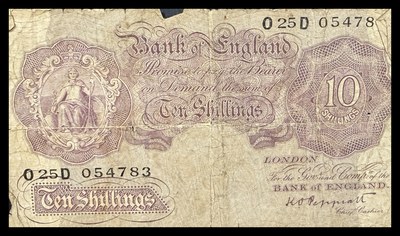
Ornate geometric guilloché pattern in mauve and cream tones typical of Bank of England wartime issue notes. The reverse design shows through due to the thin paper characteristic of this emergency wartime production period.
Back
Britannia, the female personification of Britain, seated with shield, trident and olive branch, representing British naval power and peace. She has been the primary symbol on Bank of England notes since 1694. The denomination 'Ten Shillings' appears prominently in Gothic script, with the promise to pay the bearer on demand. Serial number O25D 054783 visible at top and bottom left. Signed by Kenneth Oswald Peppiatt, Chief Cashier 1934–1949, whose signature appears on notes throughout WWII.
History
This Ten Shilling note was issued during the tenure of Chief Cashier K.O. Peppiatt (1934–1949), placing it firmly in the WWII or immediate post-war period. The Britannia design without a royal portrait was standard for Bank of England notes until 1960. Ten shillings was half a pound and remained a commonly used denomination until decimalization in 1971, when it was replaced by the 50 pence coin. This note shows significant circulation wear consistent with wartime usage. The O25D prefix indicates a later wartime or early post-war printing run.
Linked specimens (1)
Merge into another type
Repoints every linked specimen above to the chosen target type, fills any target nulls from this type, then deletes this type. This cannot be undone.