10 Pesos Bolivianos BOB #58
Peso Boliviano series
(1962–1963)
· issued 1962
· 154a
· common
Type details
| Country | Bolivia |
| Currency | BOB |
| Denomination | 10 Pesos Bolivianos |
| Series | Peso Boliviano series |
| Series year | 1962 |
| Series range | 1962–1963 |
| Issue year | 1962 |
| Issuer | Banco Central de Bolivia |
| Signatures | Gerente: [illegible signature]; Presidente: [illegible signature] |
| Printer | Thomas De La Rue & Company, Limited |
| Front portrait | Germán Busch Becerra |
| Reverse subject | Cerro de Potosí with colonial architecture |
| Themes | military,statesman,architecture |
| Security features | microprint,intaglio |
| Colour palette | #6b7c4a,#d4c5a0,#2d3b1f |
| Material | paper |
| Dimensions (mm) | 156x67 |
| Language / script | Latin |
| Languages | es |
| Pick # | 154a |
| Rarity | common |
| Legal status | demonetized |
| Legal status date | 1987 |
| Predecessor currency | Boliviano |
| Successor currency | Peso Boliviano (1963 reform), later Boliviano (1987) |
| Era | 1946_1989 |
| Default value (low) | 5.0 |
| Default value (high) | 15.0 |
| Value currency | USD |
Front
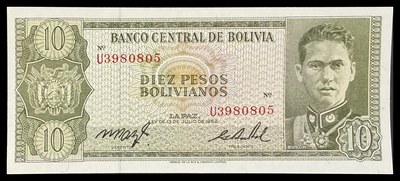
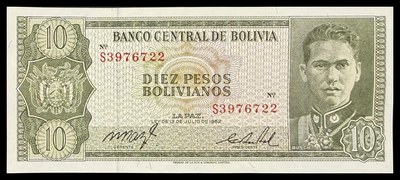
Germán Busch Becerra (1903–1939), Bolivian military officer and president of Bolivia from 1937 to 1939. He rose to prominence during the Chaco War against Paraguay and became a nationalist leader who attempted progressive economic reforms, particularly regarding Bolivia's natural resources and tin industry. His presidency ended with his death in 1939, officially ruled a suicide though circumstances remain debated. The note also displays the Bolivian coat of arms at left, featuring the national condor, alpaca, breadfruit tree, and Cerro de Potosí.
Back
Cerro de Potosí (Cerro Rico) with colonial-era buildings and churches in the foreground. Potosí was one of the richest silver mining centers in the Spanish colonial empire, and Cerro Rico (Rich Mountain) became legendary as the source of vast quantities of silver extracted from the 16th to 18th centuries. The mountain and the historic colonial architecture of Potosí represent Bolivia's mining heritage and colonial history, which fundamentally shaped the nation's economy and society.
History
This note belongs to the Peso Boliviano series issued under the Law of 13 July 1962 (as printed on the face: 'LEY DE 13 DE JULIO DE 1962'). The Peso Boliviano was introduced in 1963 to replace the previous Boliviano at a rate of 1,000 to 1 following a period of significant inflation. This transitional series bears the 1962 law date but circulated from 1962–1963. The currency was later replaced by the new Boliviano in 1987 at a rate of 1,000,000 pesos bolivianos to 1 boliviano during hyperinflation. Thomas De La Rue printed this series, and the design honors Germán Busch, who remains an important figure in Bolivian nationalist history.
Linked specimens (2)
Merge into another type
Repoints every linked specimen above to the chosen target type, fills any target nulls from this type, then deletes this type. This cannot be undone.