500 dinara Yugoslav dinar #593
1978-1981 series
(1978-1981)
· issued 1981
· 92a
· common
Type details
| Country | Yugoslavia |
| Currency | Yugoslav dinar |
| Denomination | 500 dinara |
| Series | 1978-1981 series |
| Series year | 1981 |
| Series range | 1978-1981 |
| Issue year | 1981 |
| Issuer | Narodna Banka Jugoslavije |
| Issuer (native) | Народна Банка Југославије |
| Signatures | Guverner: (signature illegible); Zamjenik Guvernera: (signature illegible) |
| Printer | Zavod za izradu novčanica, Beograd |
| Front portrait | Yugoslav woman in traditional folk costume |
| Themes | indigenous_culture |
| Watermark | Portrait in circular guilloche pattern at left |
| Security features | microprint, intaglio, guilloche_patterns |
| Colour palette | #8b7355,#d4c5a9,#4a4a4a |
| Material | paper |
| Dimensions (mm) | 172x85 |
| Language / script | Latin, Cyrillic |
| Languages | sr,mk,sl |
| Pick # | 92a |
| Rarity | common |
| Legal status | demonetized |
| Legal status date | 1992 |
| Successor currency | New dinar |
| Era | 1946_1989 |
| Default value (low) | 2.0 |
| Default value (high) | 8.0 |
| Value currency | USD |
Front
A woman in traditional Yugoslav folk costume with distinctive headwear, representing the cultural heritage of the South Slavic peoples. The figure symbolizes the unity and diversity of Yugoslavia's constituent republics and ethnic groups during the socialist federal period. The note displays trilingual text in Latin and Cyrillic scripts (Serbo-Croatian, Macedonian, Slovenian), reflecting Yugoslavia's multilingual character. Dated 4. XI 1981 (November 4, 1981) and issued in Belgrade (Beograd).
Back
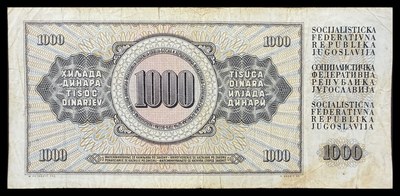
Geometric guilloche patterns and rosettes in the center with denomination 1000 dinara prominently displayed. The text 'Socijalističка Federativna Republika Jugoslavija' (Socialist Federal Republic of Yugoslavia) appears in multiple scripts. The reverse design features intricate anti-counterfeiting guilloche work typical of Yugoslav banknotes of this era, with denominations repeated in the corners and multilingual inscriptions.
History
This note belongs to the 1978-1981 series issued by the National Bank of Yugoslavia during the final decade of Josip Broz Tito's rule and the early 1980s period following his death in 1980. The series was printed at the state printing works in Belgrade (Zavod za izradu novčanica). The use of traditional folk costume imagery was a deliberate choice to represent Yugoslav unity through cultural heritage rather than political figures. The 500 dinar denomination was a mid-value note during this period of moderate inflation. The note displays signatures of the Governor and Deputy Governor of the National Bank. This series was replaced during the hyperinflationary period of the late 1980s and early 1990s that preceded Yugoslavia's dissolution. The note was demonetized in 1992 following the breakup of the Socialist Federal Republic of Yugoslavia.
Linked specimens (1)
Merge into another type
Repoints every linked specimen above to the chosen target type, fills any target nulls from this type, then deletes this type. This cannot be undone.