Type details
| Country | Yugoslavia |
| Currency | Yugoslav Dinar |
| Denomination | 10000 |
| Series | 1992 hyperinflation series |
| Series year | 1992 |
| Series range | 1992–1993 |
| Issuer | National Bank of Yugoslavia |
| Issuer (native) | Народна Банка Југославије |
| Signatures | Governor: signature visible dated 1.XI 1981 |
| Printer | Zavod za izradu novčanica i sastavni Narodne Banke Jugoslavije |
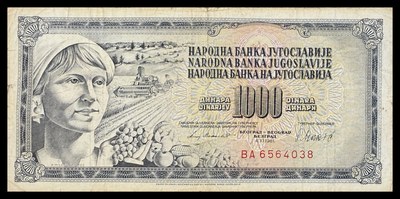
| Front portrait | Young woman in national costume |
| Reverse subject | Agricultural harvest scene with combine harvester |
| Themes | agriculture,youth,industry |
| Security features | microprint,intaglio |
| Colour palette | #d4a574,#8b4513,#f5deb3 |
| Material | paper |
| Dimensions (mm) | 154x74 |
| Language / script | Cyrillic,Latin |
| Languages | sr |
| Pick # | 116 |
| Rarity | common |
| Legal status | demonetized |
| Legal status date | 1994-01-24 |
| Predecessor currency | Yugoslav Dinar (1990) |
| Successor currency | New Dinar |
| Era | 1990_present |
| Default value (low) | 1.0 |
| Default value (high) | 5.0 |
| Value currency | USD |
Front
Young woman in traditional Yugoslav folk costume, representing the youth and agriculture of the nation. The design reflects the socialist-era emphasis on rural life and collective farming during the final years of the Socialist Federal Republic of Yugoslavia. The note was issued during the severe hyperinflation crisis that preceded the breakup of Yugoslavia.
Back
Agricultural harvest scene featuring a combine harvester in wheat fields with workers gathering produce including corn, grapes, and other crops. This imagery symbolizes Yugoslavia's agricultural productivity and the importance of farming to the economy. The scene emphasizes the collective agricultural model promoted during the socialist period, though this note circulated during the country's economic collapse.
History
This 10,000 dinar note belongs to the 1992 series issued by the National Bank of Yugoslavia during the catastrophic hyperinflation that accompanied the disintegration of the Socialist Federal Republic of Yugoslavia. The series was printed with a 1981 signature date but circulated from 1992 to 1993 as the dinar collapsed in value. Within months, denominations escalated into the millions and billions as Yugoslavia experienced one of the worst hyperinflations in history, second only to Hungary 1946. The note was demonetized on January 24, 1994, when the 1994 New Dinar replaced the old dinar at a rate of 1:1,000,000. This series is characterized by reused designs from earlier periods with updated denominations to meet the demands of rapidly escalating prices. Pick number P-116.
Linked specimens (1)
Merge into another type
Repoints every linked specimen above to the chosen target type, fills any target nulls from this type, then deletes this type. This cannot be undone.