5000000 Yugoslav Dinar #599
Hyperinflation series
(1993–1994)
· issued 1993
· P-133
· common
Type details
| Country | Yugoslavia |
| Currency | Yugoslav Dinar |
| Denomination | 5000000 |
| Series | Hyperinflation series |
| Series year | 1993 |
| Series range | 1993–1994 |
| Issue year | 1993 |
| Issuer | National Bank of Yugoslavia |
| Issuer (native) | Народна Банка Југославије |
| Signatures | Governor: signature visible but name not clearly legible |
| Front portrait | Nikola Tesla monument statue |
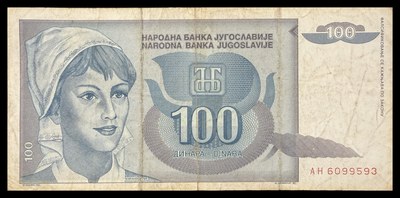
| Reverse subject | Young woman with traditional Serbian jewelry |
| Themes | scientist,industry,indigenous_culture |
| Security features | microprint,intaglio |
| Colour palette | #8b6f47,#c4a582,#4a3428 |
| Material | paper |
| Dimensions (mm) | 155x73 |
| Language / script | Cyrillic, Latin |
| Languages | sr |
| Pick # | P-133 |
| Rarity | common |
| Legal status | demonetized |
| Legal status date | 1994-01-24 |
| Predecessor currency | Yugoslav Dinar (1990) |
| Successor currency | Yugoslav Dinar (1994 reform) |
| Era | 1990_present |
| Default value (low) | 5.0 |
| Default value (high) | 15.0 |
| Value currency | USD |
Front
Nikola Tesla monument statue, depicting the Serbian-American inventor and electrical engineer (1856–1943) who pioneered alternating current electricity systems. The monument shows Tesla in traditional Serbian dress with an Orthodox cross visible on his chest. Behind the statue is a depiction of the Đerdap I hydroelectric power station (Iron Gate I) on the Danube River, one of Europe's largest power plants, completed in 1972 as a joint Yugoslav-Romanian project. This note was issued during Yugoslavia's catastrophic hyperinflation period when the dinar lost value at an astronomical rate.
Back
Portrait of a young Serbian woman wearing traditional folk costume and jewelry, representing Yugoslav cultural heritage. The woman wears an ornate necklace typical of Serbian traditional dress. The design emphasizes cultural identity during a period of severe economic crisis and impending national dissolution. Text reads 'NARODNA BANKA JUGOSLAVIJE' (National Bank of Yugoslavia) with denomination '100 DINARA' overprinted on the existing 5,000,000 note.
History
This is a critically important hyperinflation note from the final years of Yugoslavia. Printed in Belgrade in 1993 and dated 'BEOGRAD 1993', it belongs to the series issued during one of history's worst hyperinflations. The 5,000,000 dinar denomination itself indicates extreme currency devaluation. What makes this specimen particularly significant is the '100' overprint visible on the back — during 1993–1994, Yugoslavia went through multiple currency reforms attempting to stabilize the dinar, and existing high-denomination notes were sometimes overprinted with new values as emergency measures. The note shows 'FALSIFIKOVANIE SE KAŽNJAVA PO ZAKONU' (counterfeiting is punished by law) on the front. The hyperinflation peaked in January 1994 with monthly inflation reaching 313 million percent. The Yugoslav dinar was replaced on January 24, 1994, by a new dinar at a rate of 1 new dinar = 1,000,000,000 old dinars. This series represents the economic collapse that accompanied Yugoslavia's disintegration. Serial number visible: AH 6099593.
Linked specimens (1)
Merge into another type
Repoints every linked specimen above to the chosen target type, fills any target nulls from this type, then deletes this type. This cannot be undone.