Type details
| Country | Bosnia and Herzegovina |
| Currency | BAM |
| Denomination | 10 |
| Series | First issue |
| Series year | 1992 |
| Series range | 1992–1998 |
| Issue year | 1992 |
| Issuer | National Bank of Bosnia and Herzegovina |
| Issuer (native) | Народна банка Босне и Херцеговине |
| Signatures | Guverner: signature present but illegible |
| Reverse subject | Stećak medieval tombstone |
| Themes | indigenous_culture,commemorative |
| Security features | guilloche_rosette,microprint |
| Colour palette | #d8b5d8,#ffb6c1,#f5e6d3 |
| Material | paper |
| Dimensions (mm) | 140x70 |
| Language / script | Latin, Cyrillic |
| Languages | bs,hr,sr |
| Pick # | P-10 |
| Rarity | common |
| Legal status | demonetized |
| Legal status date | 1998 |
| Predecessor currency | Yugoslav dinar |
| Successor currency | Convertible mark |
| Era | 1990_present |
| Default value (low) | 1.0 |
| Default value (high) | 3.0 |
| Value currency | USD |
Front
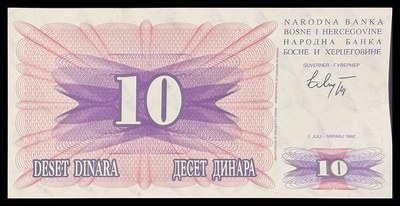
Abstract guilloche rosette pattern in pink and purple creating an ornate security design. The note bears the denomination '10 DESET DINARA' (ten dinars) in Latin and Cyrillic scripts, issued by the Narodna Banka Bosne i Hercegovine (National Bank of Bosnia and Herzegovina). Dated '1. JULI – SRPANJ 1992', this represents the first currency issue following Bosnia and Herzegovina's declaration of independence during the breakup of Yugoslavia.
Back
Stećak medieval tombstone depicted within a circular vignette. Stećci are monumental medieval tombstones unique to Bosnia and Herzegovina and surrounding regions, dating from the 12th to 16th centuries, and recognized as UNESCO World Heritage. These distinctive stone monuments represent an important cultural symbol of medieval Bosnian identity and are among the most significant archaeological heritage of the region.
History
The Bosnian dinar was introduced on 1 July 1992 following Bosnia and Herzegovina's independence from Yugoslavia in March 1992. This first issue series (1992–1998) was produced during the Bosnian War and severe hyperinflation that characterized the early years of independence. The dinar was replaced by the convertible mark (konvertibilna marka) in 1998 at a rate of 1 mark = 100 dinars as part of the Dayton Agreement's economic stabilization measures. The choice of stećci as a motif reflects an attempt to use culturally neutral, pre-Ottoman symbols that could represent all ethnic groups in the newly independent state.
Linked specimens (1)
Merge into another type
Repoints every linked specimen above to the chosen target type, fills any target nulls from this type, then deletes this type. This cannot be undone.