Type details
| Country | Yugoslavia |
| Currency | YUD |
| Denomination | 100 |
| Series | 1992 Reform Dinar Series |
| Series year | 1992 |
| Series range | 1992–1993 |
| Issue year | 1992 |
| Issuer | National Bank of Yugoslavia |
| Issuer (native) | Народна банка Југославије |
| Signatures | Governor: Dragoslav Avramović |
| Printer | Zavod za izradu novčanica i kovanog novca - Beograd |
| Themes | agriculture |
| Watermark | Geometric pattern with denomination |
| Security features | microprint,intaglio |
| Colour palette | #8fa5b5,#c4b5a6,#6b7a8a |
| Material | paper |
| Dimensions (mm) | 145x69 |
| Language / script | Latin,Cyrillic |
| Languages | sr,sh |
| Pick # | P-112 |
| Rarity | common |
| Legal status | demonetized |
| Legal status date | 1993 |
| Predecessor currency | Yugoslav dinar (1990 series) |
| Successor currency | Yugoslav dinar (1993 October reform) |
| Era | 1990_present |
| Default value (low) | 0.25 |
| Default value (high) | 1.5 |
| Value currency | USD |
Front
Abstract design featuring stylized wheat sheaves representing Yugoslav agriculture. The note displays the denomination '100' and text in both Cyrillic (ЈУГОСЛАВИЈА) and Latin (JUGOSLAVIJA) scripts, reflecting the multi-ethnic nature of the Federal Republic of Yugoslavia. The design is notably abstract compared to earlier Yugoslav issues, part of the emergency-style notes issued during the hyperinflationary period. Printed in Belgrade, 1992.
Back
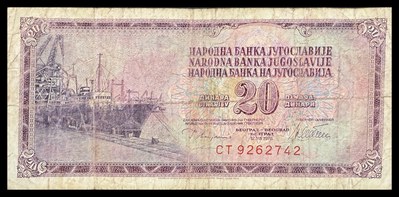
This appears to be a mismatched image showing a 20 dinara note from the 1978 series featuring a Yugoslav port scene with cargo cranes and ships, representing industrial development. The note shows serial number CT 9262742 and is dated 12.VIII.1978. This is NOT the reverse of the 100 dinara 1992 note shown in the front image.
History
The 100 dinara note from 1992 was issued by the Federal Republic of Yugoslavia (Serbia and Montenegro) during the early stages of hyperinflation that would devastate the country's economy. Following the breakup of Yugoslavia in 1991-1992, the rump state experienced severe economic crisis due to international sanctions and war costs. This series was quickly superseded as inflation accelerated, leading to the famous 500 billion dinar notes by 1993. The July 1992 reform (1 new dinar = 10 old dinars) was the first of several redenominations. The note was printed at the Yugoslav Institute for Manufacturing Banknotes and Coins in Belgrade (Zavod za izradu novčanica i kovanog novca).
Linked specimens (1)
Merge into another type
Repoints every linked specimen above to the chosen target type, fills any target nulls from this type, then deletes this type. This cannot be undone.