Type details
| Country | Japan |
| Currency | Yen |
| Denomination | 100 |
| Series | Nippon Ginko Convertible Note |
| Series range | 1946–1953 |
| Issuer | Nippon Ginko (Bank of Japan) |
| Issuer (native) | 日本銀行 |
| Printer | Printing Bureau, Ministry of Finance |
| Reverse subject | Mount Fuji |
| Themes | architecture,wildlife |
| Security features | intaglio |
| Colour palette | #8b7355,#d4a76a,#3d2817 |
| Material | paper |
| Dimensions (mm) | 162x93 |
| Language / script | Latin script (front), Japanese kanji and hiragana (back) |
| Languages | en,ja |
| Pick # | 89 |
| Rarity | common |
| Legal status | demonetized |
| Legal status date | 1958 |
| Era | 1946_1989 |
| Default value (low) | 3.0 |
| Default value (high) | 10.0 |
| Value currency | USD |
Front
The National Diet Building in Tokyo, completed in 1936 as the seat of Japan's bicameral legislature. The building's distinctive pyramid-shaped tower and neoclassical architecture made it a symbol of Japan's parliamentary democracy and was featured on currency during the post-WWII reconstruction period. The text 'NIPPON GINKO' appears at top with '100 YEN' at bottom.
Back
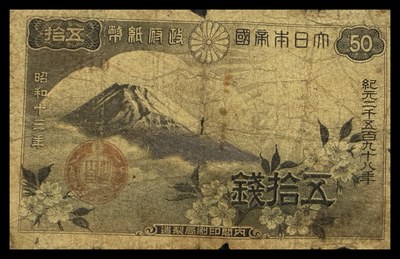
Mount Fuji, Japan's highest and most sacred mountain at 3,776 meters, depicted with cherry blossoms (sakura) in the foreground. Fuji-san has been a central symbol of Japanese culture and spirituality for centuries, revered in Shinto tradition and featured extensively in Japanese art. The Imperial chrysanthemum seal appears at top center. Vertical text on the right reads the denomination in Japanese characters.
History
This is a Nippon Ginko (Bank of Japan) convertible note from the immediate post-WWII period (1946–1953), issued during the Allied Occupation. These notes were part of Japan's currency stabilization efforts following WWII hyperinflation and economic collapse. The series featured Japanese architectural and natural landmarks—deliberately chosen to rebuild national identity while being acceptable to occupation authorities. The 100 yen denomination was a workhorse note during reconstruction. These notes were replaced by the 1950s series Bank of Japan notes and formally demonetized in 1958. The red seal visible on the front is the Bank of Japan validation stamp. The series is catalogued as P-89 in the Standard Catalog of World Paper Money.
Linked specimens (1)
Merge into another type
Repoints every linked specimen above to the chosen target type, fills any target nulls from this type, then deletes this type. This cannot be undone.