Type details
| Country | Serbia |
| Currency | Dinar |
| Denomination | 50 |
| Series | German occupation series |
| Series year | 1942 |
| Series range | 1941–1944 |
| Issue year | 1942 |
| Issuer | Srpska Narodna Banka |
| Issuer (native) | Српска Народна Банка |
| Signatures | Governor: Ljubo Jovanović |
| Front portrait | Peter II of Yugoslavia |
| Reverse subject | Serbian cross with four firesteels (ocila) |
| Themes | monarch,commemorative |
| Security features | intaglio,microprint |
| Colour palette | #8b6f47,#d4a574,#2b1810 |
| Material | paper |
| Language / script | Cyrillic |
| Languages | sr |
| Pick # | 27a |
| Rarity | common |
| Legal status | demonetized |
| Legal status date | 1944 |
| Predecessor currency | Serbian dinar |
| Successor currency | Yugoslav dinar |
| Era | 1900_1945 |
| Default value (low) | 5.0 |
| Default value (high) | 15.0 |
| Value currency | USD |
Front
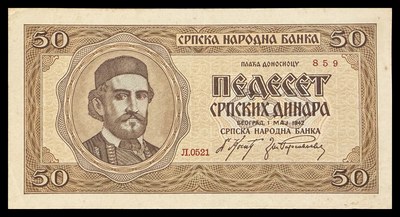
Peter II of Yugoslavia (1923–1970), the last King of Yugoslavia who reigned from 1934 to 1945. He was overthrown as a minor in 1941 when the Axis powers invaded Yugoslavia, spending the war years in exile. This note was issued by the collaborationist Serbian puppet government under German occupation during World War II, using the young king's image despite his exile and opposition to the occupation.
Back
The Serbian cross (tetragrammic cross) with four firesteels (ocila or огњила), a traditional Serbian heraldic symbol dating to medieval times. The cross and firesteels are the traditional coat of arms of Serbia, representing the four letters 'C' (Cyrillic 'S') meaning 'Само Слога Србина Спасава' ('Only Unity Saves the Serbs'). This symbol has been used on Serbian banknotes and official emblems throughout various historical periods.
History
This 50 dinar note was issued by the Srpska Narodna Banka (Serbian National Bank) on May 1, 1942, during the German occupation of Serbia in World War II. The note is dated 'BEOGRAD, 1 MAJ 1942' (Belgrade, May 1, 1942). Despite featuring King Peter II, who was in exile and led the Yugoslav government-in-exile opposing the Axis, the note was issued by the collaborationist administration under German control. This series (1941–1944) represents a complex period where occupation authorities maintained some Serbian national symbols while controlling the puppet government of Milan Nedić. The currency was replaced after liberation in 1944.
Linked specimens (1)
Merge into another type
Repoints every linked specimen above to the chosen target type, fills any target nulls from this type, then deletes this type. This cannot be undone.