Currency startsMore than 1,000 years of £sd lineage
Paper-money timeline1694
National / central issueBank of England notes from 1694
Current issuerBank of England and authorised commercial banks
The essential story
Start with the chronology, not the current issuer.
Bank of England notes began in 1694 as handwritten promises and gradually became standardised, pictorial and highly secure. Sterling itself is much older, so the currency and banknote timelines should remain distinct.
The United Kingdom is not a single-issuer catalogue. The Bank of England issues notes for England and Wales, while authorised banks issue distinct Scottish and Northern Irish notes.
History in layers
Banknote eras
Dates describe what began in each period—not necessarily when every note stopped circulating.
01
1694–1724
Handwritten running-cash notes
Early notes were completed by hand for the deposited sum rather than printed in fixed modern denominations.
02
1725–1914
Part-printed and White Notes
Fixed denominations and a recognisable monochrome design language emerged over two centuries.
03
1914–1956
Treasury emergency notes and Series A
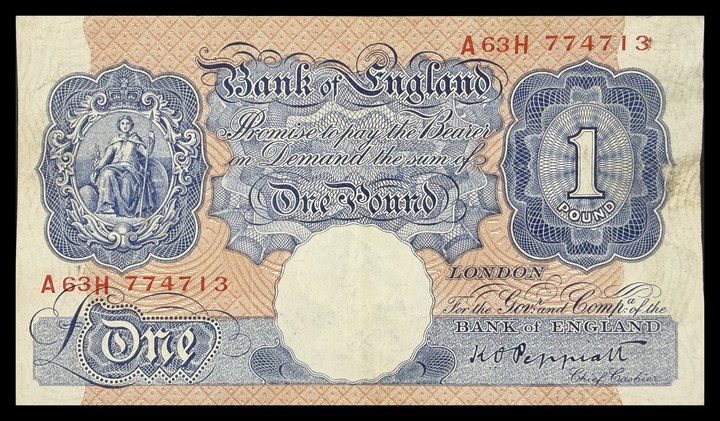
War transformed low-denomination paper money and led into the first coloured Bank of England £1 note in 1928.
04
1957–1989
Portrait and pictorial modernisation
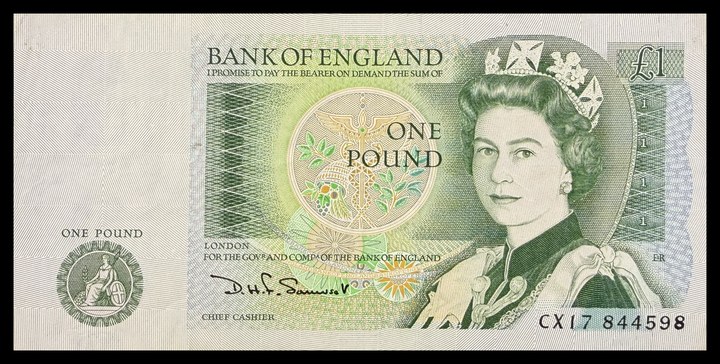
Elizabeth II became the first monarch on a Bank of England note in 1960; Shakespeare became the first historical figure on the reverse in 1970.
05
1990–2016
Series E and F paper designs
Historical figures, larger portraits and increasingly sophisticated security features shaped the final paper era.
06
2016–present
Series G polymer
The full polymer family entered circulation from 2016 to 2021. Charles III portrait variants joined circulation in 2024.
Collector’s lens
Details worth cataloguing
01
Issuer is essential
Keep Bank of England, Scottish and Northern Irish issuing banks separate before comparing series or denominations.
02
Chief cashier and prefix
Signatory, serial prefix and paper or polymer substrate often distinguish collectible variants.
03
Monarch changes are portrait variants
Charles III notes retain the existing reverse figures; they are not a wholly new reverse-design series.
04
Withdrawn notes remain redeemable
The Bank of England exchanges its own withdrawn notes at face value indefinitely, but not notes from other issuers.
Issue catalogue
Series and denominations
0 of 653
documented issues represented · generated
2026-08-01
○
Missing
Variable Irish-pound and sterling sums
1700–1825
Major private-bank and merchant-note group; private notes were widespread in Ireland before the Bank of Ireland's nationwide issues.
02Bank of Ireland first issue
Bank of Ireland
1783
0/16⌄
○
Missing
£10 Irish
1783
First Bank of Ireland issue; no surviving examples reported.
○
Missing
£100 Irish
1783
First Bank of Ireland issue; no surviving examples reported.
○
Missing
£15 Irish
1783
First Bank of Ireland issue; no surviving examples reported.
○
Missing
£20 Irish
1783
First Bank of Ireland issue; no surviving examples reported.
○
Missing
£200 Irish
1783
First Bank of Ireland issue; no surviving examples reported.
○
Missing
£25 Irish
1783
First Bank of Ireland issue; no surviving examples reported.
○
Missing
£30 Irish
1783
First Bank of Ireland issue; no surviving examples reported.
○
Missing
£300 Irish
1783
First Bank of Ireland issue; no surviving examples reported.
○
Missing
£40 Irish
1783
First Bank of Ireland issue; no surviving examples reported.
○
Missing
£400 Irish
1783
First Bank of Ireland issue; no surviving examples reported.
○
Missing
£50 Irish
1783
First Bank of Ireland issue; no surviving examples reported.
○
Missing
£500 Irish
1783
First Bank of Ireland issue; no surviving examples reported.
○
Missing
£60 Irish
1783
First Bank of Ireland issue; no surviving examples reported.
○
Missing
£70 Irish
1783
First Bank of Ireland issue; no surviving examples reported.
○
Missing
£80 Irish
1783
First Bank of Ireland issue; no surviving examples reported.
○
Missing
£90 Irish
1783
First Bank of Ireland issue; no surviving examples reported.
01Bank of Scotland fixed-value notes (Scottish monetary system)
Bank of Scotland
1696–1707
0/6⌄
○
Missing
£10 Scots
1696–1707
One of the Bank of Scotland's first fixed-value note denominations.
○
Missing
£100 Scots
1696–1707
One of the Bank of Scotland's first fixed-value note denominations.
○
Missing
£20 Scots
1696–1707
One of the Bank of Scotland's first fixed-value note denominations.
○
Missing
£5 Scots
1696–1707
One of the Bank of Scotland's first fixed-value note denominations.
○
Missing
£50 Scots
1696–1707
One of the Bank of Scotland's first fixed-value note denominations.
○
Missing
£12 Scots (equivalent to £1 sterling)
1704–1707
The Bank of Scotland's first £1-equivalent note; the separate pound-Scots currency ended with the 1707 Union.
02Bank of England notes
Bank of England
1694
0/20⌄
○
Missing
Variable sterling sums
1694
Britannia medallion and promise-to-pay textInitial sealed bills, running-cash notes and other Bank paper were for variable sums; running-cash notes were the principal forerunner of modern Bank of England notes.
○
Missing
£1,000 White (official first-issue range 1725–1745)
1725
BritanniaThe Bank of England dates first issue only as between 1725 and 1745; Country-branch issue was limited to Hull, 1882–1889.
○
Missing
£100
1725
BritanniaPart of the first standard printed-denomination group.
○
Missing
£20
1725
BritanniaPart of the first standard printed-denomination group.
○
Missing
£200 White (official first-issue range 1725–1745)
1725
BritanniaThe Bank of England dates first issue only as between 1725 and 1745; Not issued by Bank of England country branches.
○
Missing
£30
1725
BritanniaPart of the first standard printed-denomination group.
○
Missing
£300 White (official first-issue range 1725–1745)
1725
BritanniaThe Bank of England dates first issue only as between 1725 and 1745; Not issued by Bank of England country branches.
○
Missing
£40
1725
BritanniaPart of the first standard printed-denomination group.
○
Missing
£50
1725
BritanniaPart of the first standard printed-denomination group.
○
Missing
£500 White (official first-issue range 1725–1745)
1725
BritanniaThe Bank of England dates first issue only as between 1725 and 1745; Issued by some Bank of England country branches from 1826.
○
Missing
£60 White (official first-issue range 1725–1740)
1725
BritanniaThe Bank of England dates first issue only as between 1725 and 1740; The exact first-issue year is not known.
○
Missing
£70 White (official first-issue range 1725–1745)
1725
BritanniaThe Bank of England dates first issue only as between 1725 and 1745; The exact first-issue year is not known.
○
Missing
£80 White (official first-issue range 1725–1745)
1725
BritanniaThe Bank of England dates first issue only as between 1725 and 1745; The exact first-issue year is not known.
○
Missing
£90 White (official first-issue range 1725–1745)
1725
BritanniaThe Bank of England dates first issue only as between 1725 and 1745; The exact first-issue year is not known.
○
Missing
£10
1759
BritanniaIntroduced during the Seven Years' War metallic-currency shortage.
○
Missing
£15
1759
BritanniaIntroduced with the first £10 notes.
○
Missing
£25
1765
Britannia
○
Missing
£5
1793
BritanniaFirst printed £5 issue.
○
Missing
£1
1797–1826
BritanniaFirst issued on 2 March 1797 during the Restriction Period; additionally issued in the 1825–1826 crisis.
○
Missing
£2
1797–1821
BritanniaEmergency low-denomination issue during the Restriction Period.
03Royal Bank of Scotland early notes
Royal Bank of Scotland
1727
0/1⌄
○
Missing
20 shillings (£1)
1727
King George IIDated 8 December 1727; from the bank's first set of notes and the first British banknote with a royal portrait. The handwritten £12-Scots equivalent was residual terminology, not a separate post-1707 currency.
04British Linen Company promissory notes and banknotes
British Linen Company
1747–1905
0/2⌄
○
Missing
Unspecified promissory-note values
1747
Pallas company emblemPromissory-note issue began in September 1747 for agents, weavers, manufacturers and customers.
○
Missing
Unspecified payable-on-demand banknote values
1750–1905
Pallas company emblemTrue payable-on-demand banknotes began in 1750.
20Agricultural & Commercial Bank of Ireland note issues
Agricultural & Commercial Bank of Ireland
1834–1840
0/5⌄
○
Missing
£1
1835–1840
First issue notes were all dated 10 March 1835; later issues also included £1.
○
Missing
30 shillings
1836–1840
Third issue.
○
Missing
35 shillings
1836–1840
Third issue.
○
Missing
£5
1836–1840
Third issue.
○
Missing
£3
1838–1840
Second issue.
25Bank of Ireland eighth issue
Bank of Ireland
1838–1842
0/2⌄
○
Missing
£1
1838–1842
Hibernia and Medusa headHibernia and Medusa Head issue.
○
Missing
30 shillings
1838–1842
Hibernia and Medusa headHibernia and Medusa Head issue.
26Clydesdale Bank founding issue
Clydesdale Bank
1838
0/5⌄
○
Missing
£1
1838
Issued on the bank's opening day, 7 May 1838.
○
Missing
£10
1838
Issued on the bank's opening day, 7 May 1838.
○
Missing
£100
1838
Issued on the bank's opening day, 7 May 1838.
○
Missing
£20
1838
Issued on the bank's opening day, 7 May 1838.
○
Missing
£5
1838
Issued on the bank's opening day, 7 May 1838.
28Bank of Ireland ninth issue
Bank of Ireland
1842–1849
0/4⌄
○
Missing
30 shillings
1842–1849
Hibernia and Medusa headHibernia and Medusa Head issue.
○
Missing
£1
1843–1849
Hibernia and Medusa headHibernia and Medusa Head issue.
○
Missing
£5
1845–1849
Hibernia and Medusa headHibernia and Medusa Head issue.
○
Missing
£3
1846–1849
Hibernia and Medusa headHibernia and Medusa Head issue.
33Bank of England Britannia-vignette white notes
Bank of England
1855–1956
0/5⌄
○
Missing
£10
1855–1956
Britannia vignetteWhite-note design incorporating Daniel Maclise's Britannia vignette.
○
Missing
£100
1855–1956
Britannia vignetteWhite-note design incorporating Daniel Maclise's Britannia vignette.
○
Missing
£20
1855–1956
Britannia vignetteWhite-note design incorporating Daniel Maclise's Britannia vignette.
○
Missing
£5
1855–1956
Britannia vignetteWhite-note design incorporating Daniel Maclise's Britannia vignette.
○
Missing
£50
1855–1956
Britannia vignetteWhite-note design incorporating Daniel Maclise's Britannia vignette.
○
Missing
£5
1864–1883
Hibernia and Medusa head47-branch, four-line red-Gothic branch-list type.
○
Missing
£1
1869–1883
Hibernia and Medusa headAll branches printed in red Gothic script.
○
Missing
£500
1869–1883
Hibernia and Medusa head56-branch issue; a surviving Bank of Ireland £500 note is dated 18 December 1869.
52Signature May issue
Bank of England
1876–1893
0/5⌄
○
Missing
£10
1876–1893
Chief Cashier Frank May signature issue.
○
Missing
£100
1876–1893
Chief Cashier Frank May signature issue.
○
Missing
£20
1876–1893
Chief Cashier Frank May signature issue.
○
Missing
£5
1876–1893
Chief Cashier Frank May signature issue.
○
Missing
£50
1876–1893
Chief Cashier Frank May signature issue.